
With love in the air and Valentine’s Day coming up, it seemed a good time to talk about Love in the Garden and to tell about what happened to Bachelor Button and Black-eyed Susan. Enjoy!


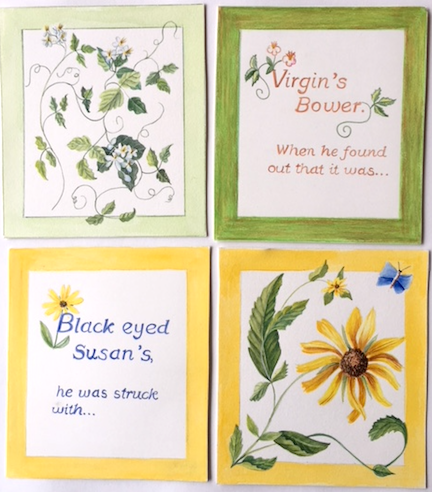

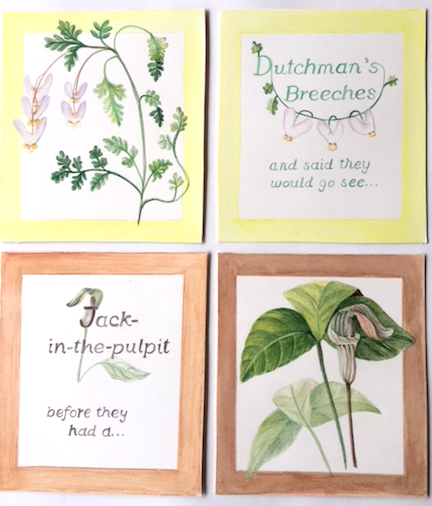

Happy Valentine’s Day to you all!!
With love in the air and Valentine’s Day coming up, it seemed a good time to talk about Love in the Garden and to tell about what happened to Bachelor Button and Black-eyed Susan. Enjoy!
Happy Valentine’s Day to you all!!
Rosemary is queen of the herb garden – and has been for millennia. The first mention of this pungent herb was on Egyptian stone tablets dating back to 5000 BC. Today, Rosemary has a seemingly endless number of “babies” or different cultivars developed from this ancient plant.
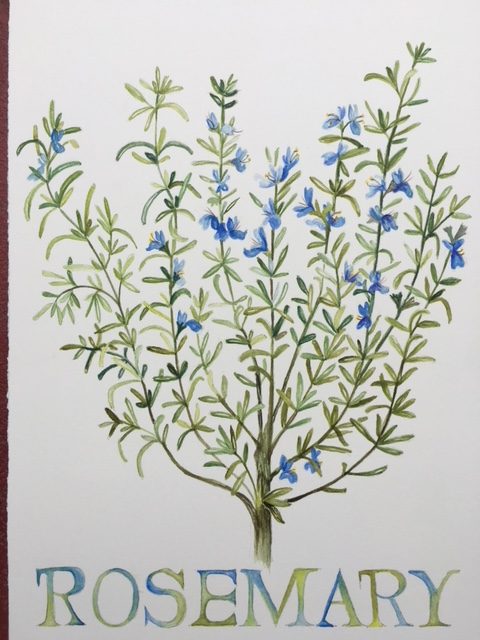
Actually all rosemaries can be grouped into two types, either upright and shrub-like or prostrate and crawling. Their blossom colors vary from blue to white, pink and lavender. Some varieties are best for cooking while others are better off to stay in the garden.
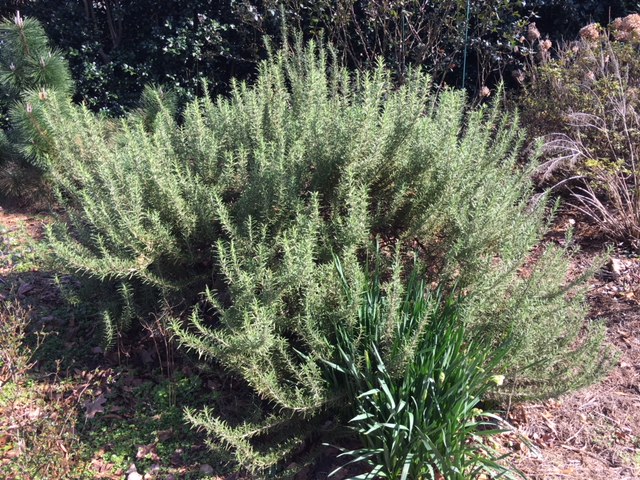
The name rosemary actually has nothing to do with roses – or girls named Mary. Instead, it’s from the Latin words ros and marinus meaning “dew of the sea.” A few years ago it was renamed Salvia rosmarinus. Formerly, it was known as Rosmarinus officinalis.
Superstitions about rosemary abound. For example, if you braid sprigs of rosemary into your hair, it will help your memory. It was also thought to have great powers of protection and would guard you against evil spirits. If you put rosemary under your pillow, it will help you have good dreams.
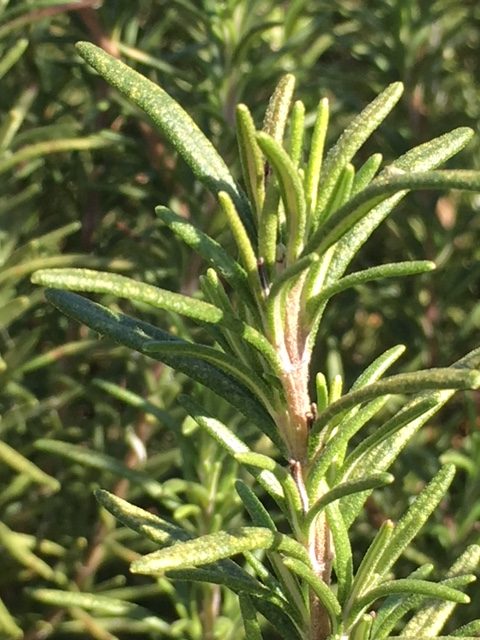
Most people use rosemary more for flavoring that for guarding against evil spirits. Because it’s mostly evergreen, it’s useful year round. Try adding a sprig of rosemary to the coals 15 minutes before grilling, or adding minced rosemary to softened butter or use it when cooking chicken or pork. Or, add a bit of rosemary to savory bread dough and bake it in.
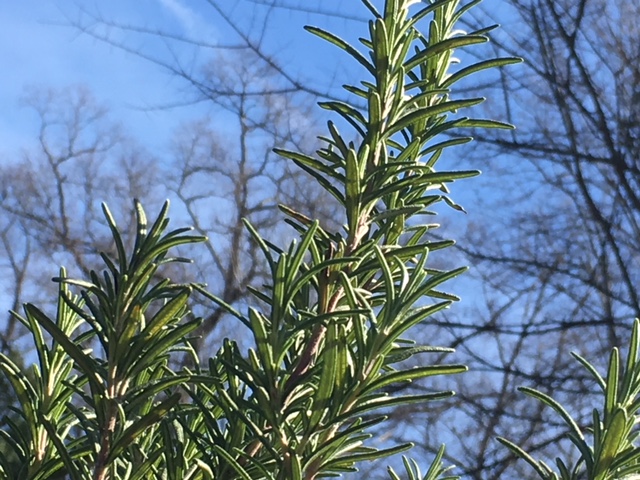
Rosemary is easy to grow and is drought tolerant, making it extra welcomed in these days of sporadic rainfall. Once a plant is growing well, lateral branches that are touching the ground tend to send out roots. If you cut these newly rooted sprouts from the mother plant and allow them to grow on their own, you’ll soon have Rosemary’s babies all over the place.
One more superstition about rosemary: if rosemary grows abundantly in a garden, it means that the woman rules the household. Now I understand why rosemary is the only shrub that Jack prunes regularly!
I usually don’t like a show off but when it comes to the brilliant red cardinal who offers a streak of color in the drab winter garden, I’m all for it!
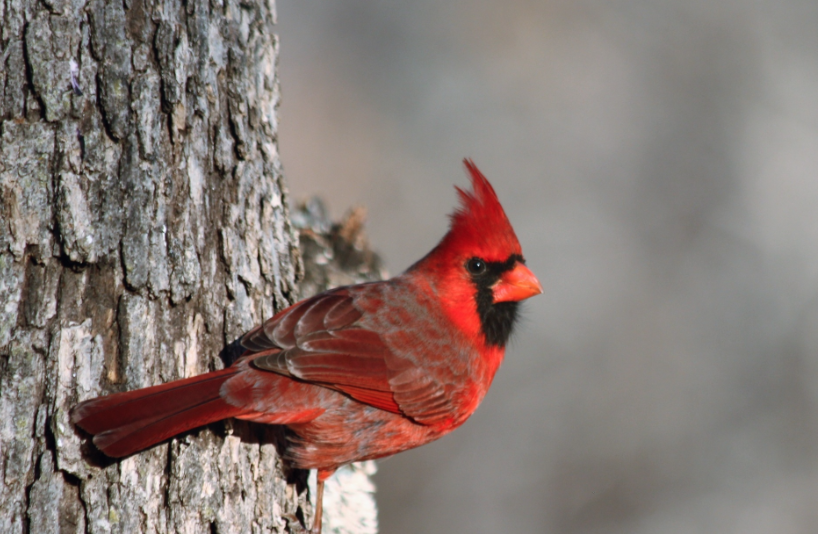
Cherokee Indians believe that the cardinal is the daughter (or son) of the sun. They have a charming legend about how this bird came to be so brilliantly colored. A long time ago cardinals were a dull brown color but one day the male cardinal found a magic pool of bright red. He jumped in, being careful not to get any around his mouth, and swam around until he was brilliantly colored. By the time he thought to call his mate, almost all the red was gone. There was only enough left for her to splash some on her chest, bill, wings and crest.
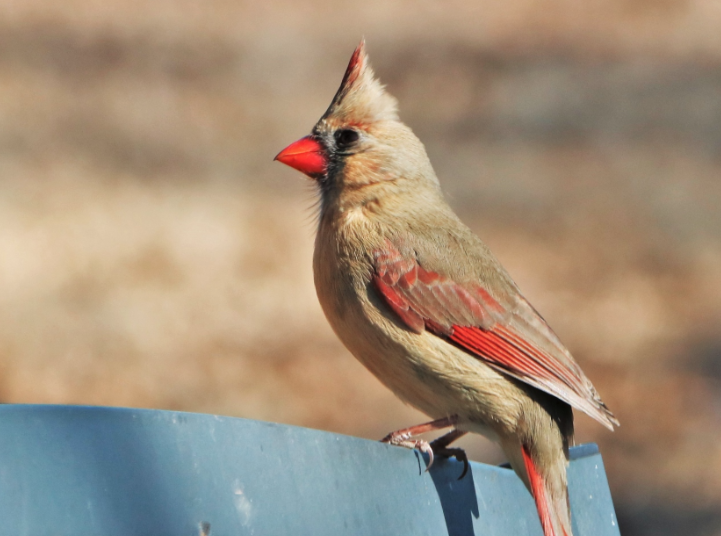
Cardinals tend to mate for life and will hang around the same general area, raising several broods during each breeding season. The males tend to be territorial and during mating / baby rearing season will aggressively fight off other birds.
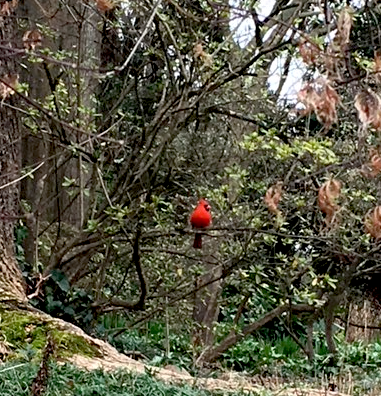
Cardinals are avid feeders and will frequent a bird feeder as long as you supply seeds (especially sunflower seeds.)
These birds are so popular that they’ve been chosen as the mascot for numerous ball teams (think baseball in St. Louis) and were chosen by seven different states as the state bird (KY, IL, IN, NC, OH, VA and WV).
The bird was named for the cardinals in the church who wear robes of the same brilliant red. The word cardinal actually comes from the Latin word, cardo, meaning “hinge” because so many decisions in the church hinged on the decisions of the cardinals (the people, not the birds).

Superstition contends that if you see a cardinal flying toward the sky, you’ll have good luck but if he’s flying toward the ground, your luck will fail. This is one superstition that I don’t believe in at all, for to me, anytime you see a cardinal flying through the air – up or down!- you’ve had a piece of good luck.
Last week when I was waxing poetic about dandelions I spent a good deal of time poking around the garden. I can’t say that it’s exactly exuberant right now but I was surprised at how prolific winter weeds can be!
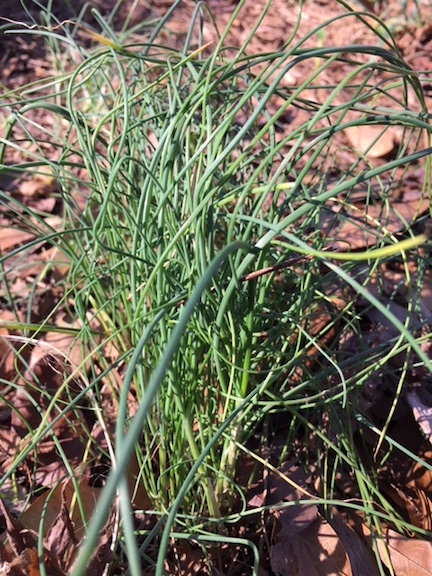
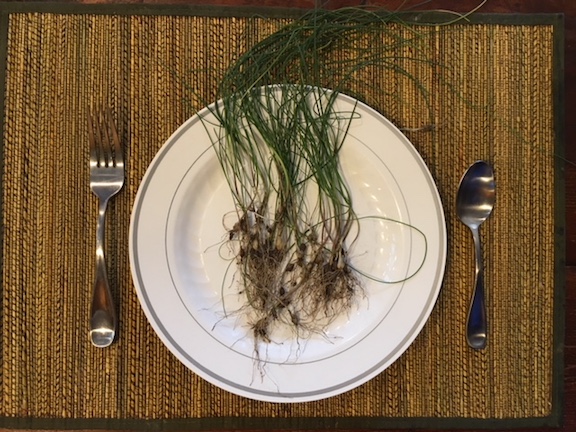
In addition to mouse – eared chickweed, which seems to be happily growing in huge masses, wild onions are popping up everywhere. Where did they all come from? It seems that no matter how diligent I am in carefully digging up the smelly little bulbs each year, there are always more and more to contend with.
I always think, though, how grateful I would be for these bulbs if I was lost and starving in the wilderness and had nothing else to eat. (Actually, the bulbs are said to be better during the second growing season but I don’t plan to be lost in the wilderness that long.) Though not many animals eat the leaves, because they are so acrid, bears, squirrels, and marmots love to dig for the bulbs.
In the Midwest, there is a wild onion called a “skunk egg,” presumably because it smells so bad. It is harvested and baked into a stew called “SOB stew.”
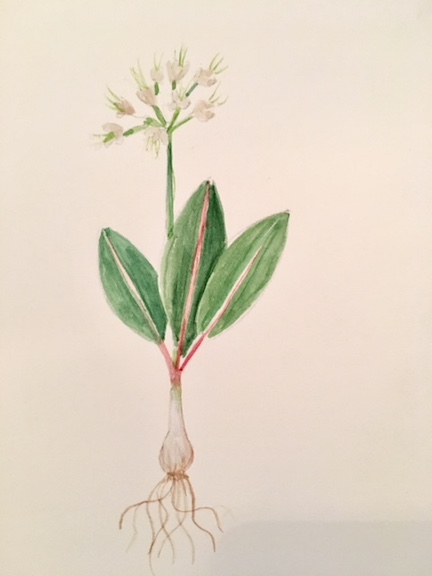
Maybe the most famous wild onion is Allium tricoccum , wild leek or “ramp” as they’re called in the south, especially in Appalachian regions. Ramps are so popular that they are heavily over – harvested now. Nevertheless, many Appalachian communities still host Ramp Festivals in spring where you can buy delicacies such as ramp jelly or pickled ramps.
Native Americans not only used the leaves of wild onion for flavoring but also crushed them to make a salve used to soothe insect and bee stings (another thing to remember if you’re lost in the wilderness!)
In the Great Lakes region, native peoples considered wild onions to be an important food staple. Their name for it was “checagou,” which many people believe was the origin for the city name, Chicago.
Hopefully none of us will need to survive on wild onions, though isn’t it a comfort to know you could! It’s enough to make you cry. Or maybe it’s just smelling all those onions.
Though the weather outside might be frightful, there are still flowers pushing the season and popping up all over the place. One of the earliest weeds (or wildflowers, depending on your point of view!) to appear is the bright yellow dandelion.
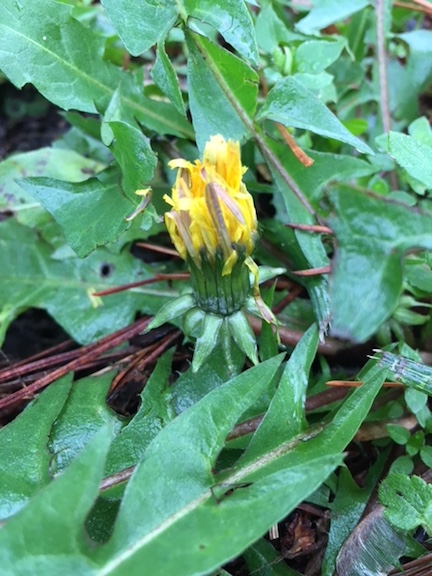
Years ago, my mother and I were traveling through New England in early spring and came upon a field of these cheerful little flowers. We stopped to admire them but when my mother realized that they were dandelions, she sniffed and said, “they would be pretty if they weren’t so common!”

Apparently this is a universal attitude. My good friend, Dr. David Bosshardt wrote to tell me that when he was traveling in Switzerland, looking for his great grandmother’s ancestral home a few years ago, he had a similar experience. He wrote: “All of the pasture land in and around Durrenroth was unbelievably bright yellow the week we were there. It was so beautiful, it almost had a fairyland appearance. These yellow waves were set in a sea of a deep green grass.
“I asked one of the farmers what all the yellow flowers were and why they were so dense. He told me they were Lowenahn. The translation of this is Tooth of the Lion in English. He seemed to have some contempt for something that grew so prolifically. Though he acknowledged their beauty, he clearly thought that they were more of a pest. “
Of course “tooth of the lion” is dent de lion in French – and dandelion in English. This name or its equivalent is used in every country where the plant grows and is descriptive of the toothed margins of the leaves. The more sunlight the plant receives, the more “teeth” the leaves have.
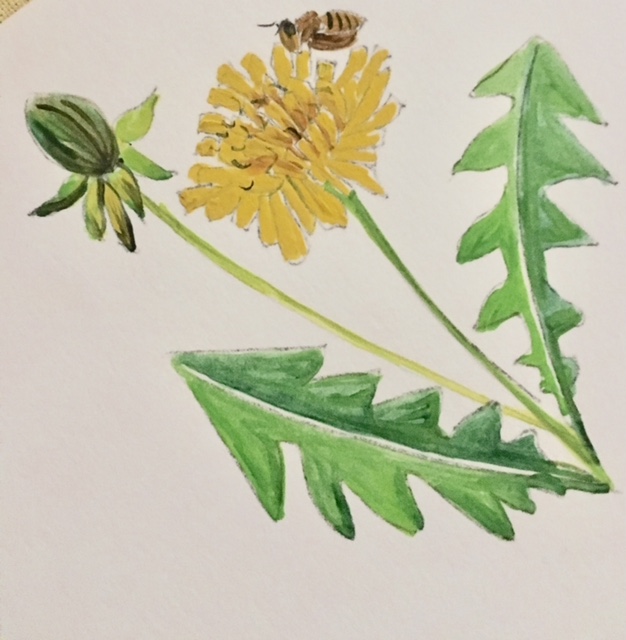
Dandelion leaves, particularly early in the season are delicious and good for you. High in vitamins A and C, the leaves have been eaten and enjoyed for many centuries. A Dutch legend contends that if you eat dandelion leaves on Mondays and Thursdays, you’ll always stay healthy!
Dandelions are native to Europe, where they are often cultivated as a salad green. The leaves, sweetest in early spring, can be eaten raw or cooked like spinach.
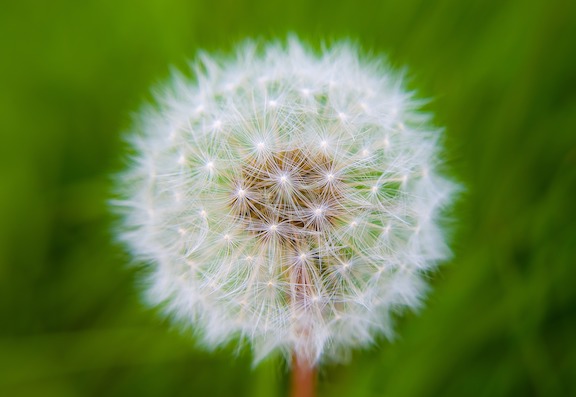
Dandelions form a seed head that has proven to be irresistible to children everywhere. Pick a fully developed seed head with seeds attached to silky parachutes, make a wish and blow on it. If all the seeds blow off, your wish will come true. (If not, just pick another and try again.)
Yes, they’re pests and yes, they’re common as dirt, but how can you resist the cheerful appearance of these bright yellow faces, particularly in mid winter when so much else looks drab and brown? Just enjoy them for what they are – a welcomed ray of sunshine.
There’s no such thing as a black thumb. Everyone can grow something! Of course when neglect is coupled with indifference, the results can be a little disheartening but the will to live in the plant world is nothing short of miraculous.
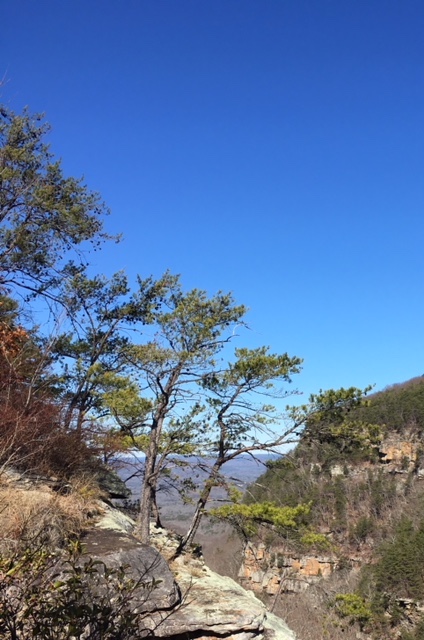
You see this in nature all the time. Trees grow in the cracks of a wall. Prickly Pear Cactus withstands temperatures that range from minus 50 in Canada to over 100 degrees F. in Mexico. Fireweed bursts forth in bloom after wildfires devastate a forest. No doubt about it, plants have a will to live that is awe inspiring.
I’m the first to admit that this Life Overdrive can sometimes be a little overwhelming. Look at an acre of kudzu and it’ll remind you of an Alfred Hictchcock movie. Try to keep weeds and moss from growing between the cracks of a stone pathway and you’ll have a never ending job on your hands.
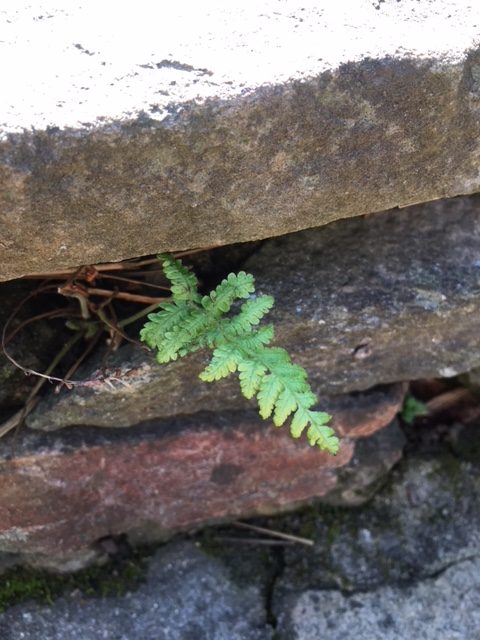
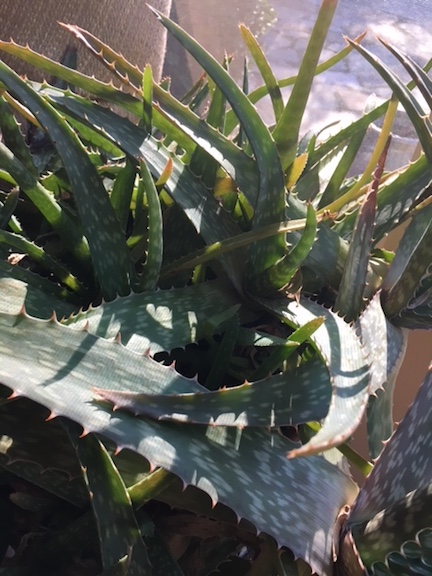
Even inside, my houseplants show true grit in the face of an uncomfortably dry and warm environment. My mother’s aloe plant that I took when she died 13 years ago has grown so much that I’ve divided, replanted and given it away a dozen times. The cute little Norfolk Island Pine that I bought as a miniature table top Christmas tree four years ago is now taller than I am and presents a logistical terror as Jack and I haul that thing out in the summer then back indoors in the winter.
Plants, like people, show endless variation and have an infinite variety of growing needs. But most plants, like most people, really only have a few basic needs; a little bit of soil with enough nutrients to grow, light and water. That pretty much covers it in nature. Interrupt the natural cycle, though, by cultivating a plant in the garden or bringing it indoors and it’s now YOUR responsibility and you’ll need to add one more thing to the list: a little love and attention.
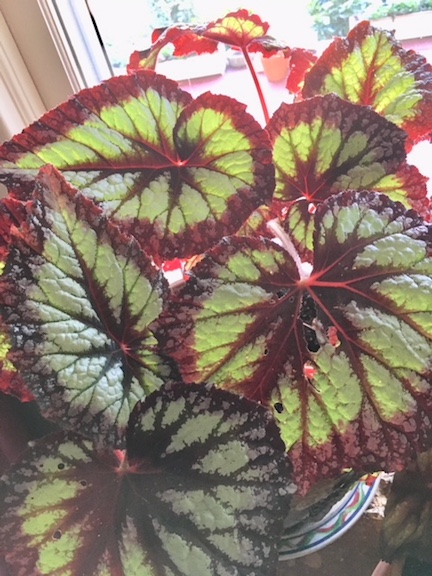
Shower your plants with love and attention, give them what they need to develop a good foundation, give them water when they’re thirsty and food when they’re hungry and sit back to watch them thrive. They will undoubtedly pay you back many times over with beauty and abundance.
P.S. This works with people too. Love to you all………
The ideas have been imagined and executed – or abandoned. Everything has been woven, stitched, baked, written, painted, or stuffed. Each grandchild has made a gift for a parent.

Everything has been wrapped and placed under the tree and what took weeks and weeks of preparation was happily and thoroughly opened in cheerful abandon in a matter of minutes. We are not a family who carefully opens gifts one at a time to ohh and ahh. More likely, we’re the sort of family to make and give gifts and at the time of opening exclaim, “Oh, I love it! I’ve always wanted one! What is it?”
With ten of us at home (and so missing those who aren’t!) there’s a lot of gift giving and general chaos ensues. I’m happy to sit back and watch. My work began in October. Everything from here on out is icing on the cake. But I do have to admit to looking forward to some quiet days before returning to the rhythm and routine of the New Year.
Part of my love of the New Year is not only looking forward but also in taking time to reflect. For those of you who read this blog with any kind of frequency (and, thank you!), it might be fun to get a year end update about some of the projects that I’ve written about.

First, the white deer is still in the woods around Lake Lanier. She is startlingly obvious. While her colleagues are almost hidden in the brown leaves and branches, she stands out like a beacon. Unfortunately, at the moment, she seems to be limping. We pray that it is not a lasting nor debilitating injury. It is still such a thrill to see her.
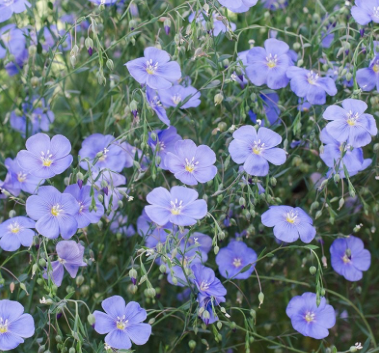
Okay, the whole idea of growing flax to get the fibers, spin them into thread and weave a handkerchief? Ha! Total flop. The flax seeds germinated and bloomed but that was about the limit to my success. I needed to be growing about 100 times as much as I did grow, I couldn’t get the “retting” process down to extract the fiber. I don’t have a spinning wheel…..I’ll save you further details.
But, on the other hand, the mass and mess of hand dyed silk thread that my sister brought me from Thailand? I finally, after weeks of untangling, wove it into a really beautiful scarf.

And, in spite of my dire predictions about the effects of a difficult long, hot summer, it seems as if the garden survived after all. Lenten rose, English primrose and forget-me-nots are all already putting forth new growth for the spring. Of course, time will tell if everything survived but the signs are hopeful. Nature’s ability to heal Herself continues to be a miracle to me. Let’s give Her all the help we can.
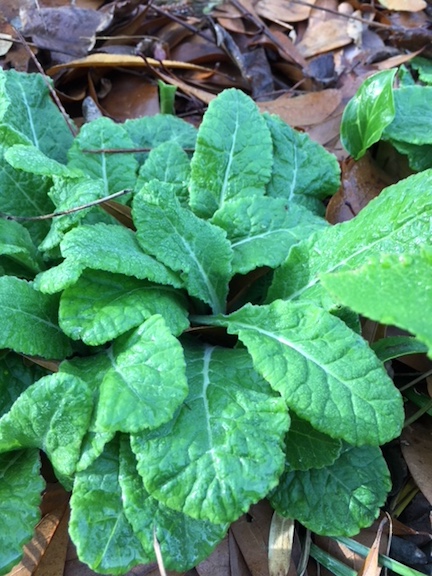
It seems that the garden (and maybe life itself), like Christmas is a happy jumble of successes and challenges. Some ideas come to fruition but the vast majority are only beautiful and functional in my own mind. Some things worked out, others did not. But I think that the most important thing is to celebrate every success, no matter how small, with joy and to meet every challenge with imagination and energy and love. As my friend the Buddhist monk told me, “when in doubt, love more.”
Happy New Year to all of you.
Among my circle of friends, there are varying opinions as to the “best” kind of Christmas tree. One of my friends can’t bear to cut down any living thing and every year, creates a Christmas tree from dead branches that she wires together to make a tree shape. She’s an incredible artist and her tree is always stunningly beautiful – and original.

Another friend, living in France, has a store-bought tree. It’s spiral shaped and collapses down to fit into a pizza box. This tree goes up and down as easily as a yo yo.
I think about this tree every year as Jack and I begin our annual discussion about our own tree. We both love our trees and have had some epic Christmas trees in our years together. And, we are in total agreement as to the kind – we are Frasier Fir fans and nothing else will do.
Where the discussion gets interesting is when we begin to talk about size. Jack, I think, would move all the furniture out of the house to get a bigger and bigger tree. I’m content with something that will at least fit through the front door. Size to me isn’t as important as all the things that go on it.

Our second “discussion” is about lights. Jack (oh horror!) suggested net lights. I thought he was surely kidding the first time he suggested it but after twenty years, I’m convinced that without me, our beloved Christmas tree would be a tangled mass of wires. Net lights indeed! Next he’ll be suggesting tinsel.
Instead, the lights go on one strand at a time and I use as many strands as it can possibly hold. (This year Jack only had to go back to purchase more lights three times!) And after the lights, of course the ornaments. Our ornaments include some fairly strange but totally beloved items. I’ve come to learn that you can hang all kinds of things on a tree and call them “ornaments.” Our collection now spans generations and is a wonderful illustration of melded families and shared memories.
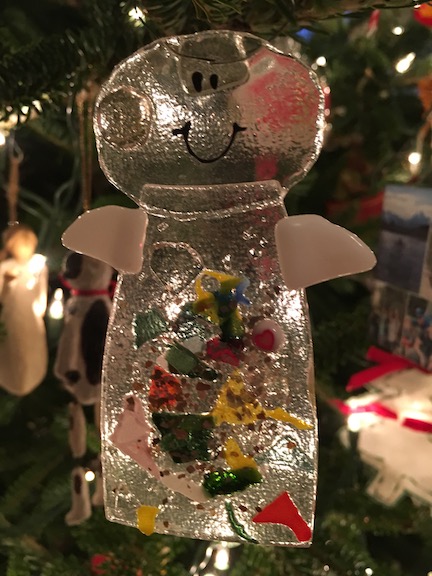
Legend tells us that the first Christmas tree was created in Germany in the 16th century when a theologian was walking home late one night and saw the stars twinkling through the branches of the evergreen trees. He decided to try to recreate this at home and cut down a tree and used candles to mimic the stars. And the rest is history that is repeated all over the world, every year.
The Christmas tree is the center of our celebration and when I think of our large and diverse family, I picture us gathered around the tree, missing the ones who aren’t with us, laughing and loving and hugging as we open gifts and share this wonderful time together. And I guess, really, even with net lights, our tree would be a wonderful backdrop for all this love.
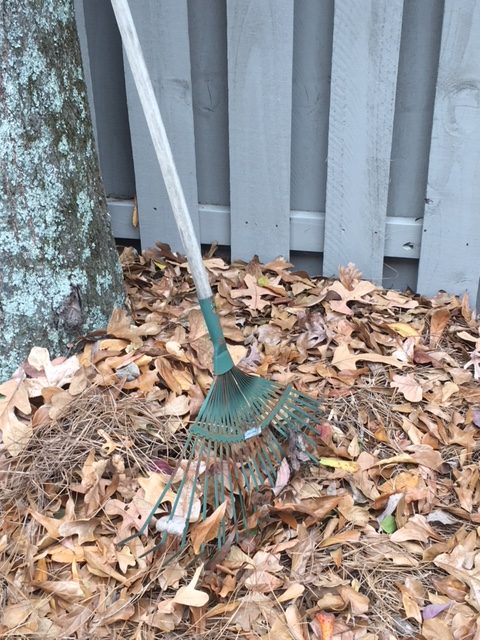
The family spent Thanksgiving at Lake Lanier last week. I was the first to arrive and barely made it up the driveway. No, it wasn’t snow or rain or mud, but a layer of leaves so thick you couldn’t tell the driveway from the yard.
Poking around in the garage, I found an old rake and after dusting it off, went outside to see what I could do. Let me tell you, raking is a very satisfying activity – especially the first five minutes. It provides instant gratification. You can tell exactly what you have done. Of course you can also tell exactly what’s left to do. All in all it took me about an hour and by the end of that time? I was a little tired but surprisingly soothed by the rhythmic action – and the quiet swoosh of the leaves as I raked them into the woods.
Most of the time, I’m happy to live in the city. There are a lot of benefits – we can walk to fabulous restaurants, we have great neighbors whom we see daily and (the best), most of our extended family lives here as well. BUT, there are drawbacks, the most fierce of which for me is the noise level. I’m not opposed to sound. I spend many hours a day making or listening to music, I love a good conversation and for goodness sakes, when the grandkids come to play, I’m the loudest of all. But incessant noise is definitely a downside of city living. And, much of this in my neighborhood comes from leaf blowers and lawn mowers.
Let me be honest, though. I am not yet to the point that I’m ready to take on raking all the leaves in our extensive yards. I just can’t do it. Which makes me part of the problem. One solution would be to get rid of all the grass, which would also eliminate the need for a lawn mower. But, I kind of like grass and it’s hard for the kids to play soccer tiptoeing through the tulips.
Another solution is a rake. Not for me, but aha! for my twelve year old grandson. I tracked him down one day and set out to convince him of all the great benefits of raking. It’ll make you strong! It’ll soothe your soul. You’ll be outside in nature. You’ll be helping out your poor old granny. I added a few more selling points and was surprised and pleased to see that he was standing watching me intently. And actually, never even protested or argued.
I was encouraged. So I finally asked, “so, what do you think? I’ll even buy you a brand new rake!” (smiley face). He kept looking at me, then pulled an earbud out of his ears. “What? did you say something?”
Sigh. Back to the drawing board on that one. I’ll go to Plan B – his nine year old sister! Ha.
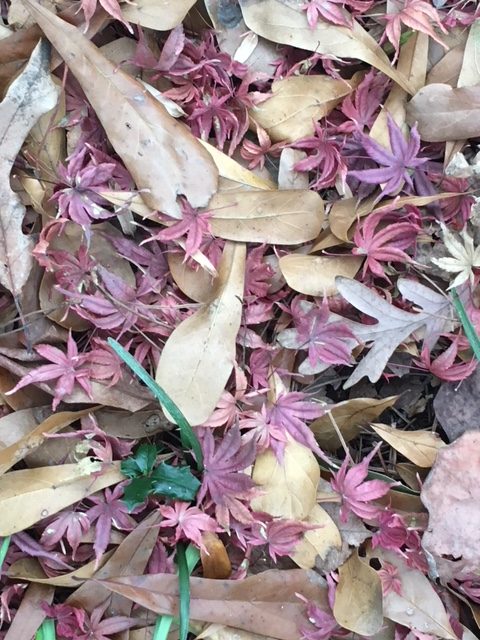
Saturday was an utterly dreary day. As I looked out through the pouring rain, the only bright spot in the garden was my Mama’s Maple tree. And it was brilliant – fiery red leaves were a welcomed sight on this rainy day.
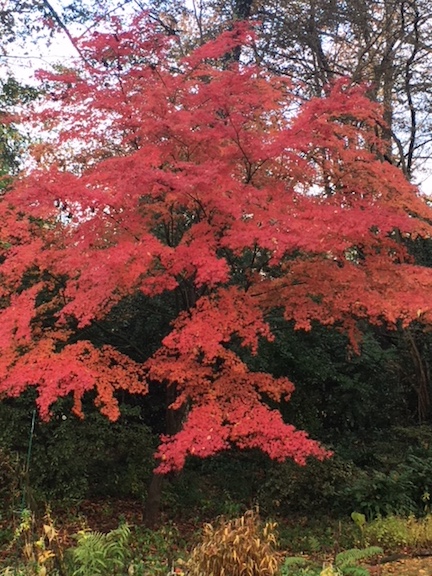
This tree had been her pride and joy. I can remember her standing at the front door looking into the woods in front of the house, exclaiming “Kids, come look at my burning bush!” And all five of us would run to the door to look, oohing and ahhing and commenting on the brilliance and beauty of the leaves. I’m not sure any one of us cared about the tree the way my Mom did, but it wasn’t the tree that we were celebrating, it was Mom and her unparalleled enthusiasm and awe for beauty in the natural world.
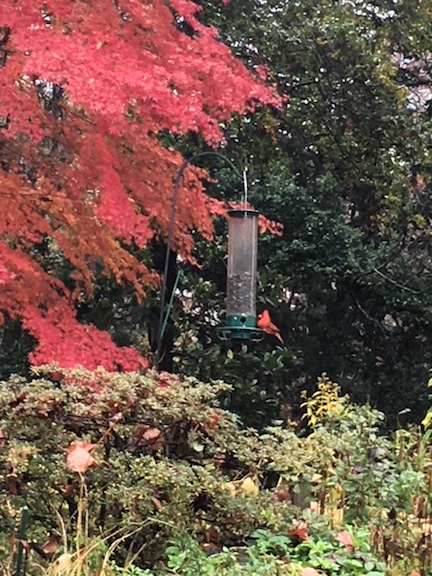
I transplanted this tree from my parents’ yard 13 years ago and though it took a few years to become accustomed to its new home, it’s now my own beacon of light and beauty. And I am so grateful for it. I love the tree, of course, but more, I love the memories that come with it. My mother, too, was a bright spot on many a rainy day for me and this tree reminds me of that.
I am so grateful for my mother’s legacy, her enthusiasm for life and her unflagging desire to share that with everyone she met. Like this maple tree, she was fiery and brilliant. Though I have lots of photographs of her and a lot of her artwork, it’s this tree that makes me remember my mother most vividly.
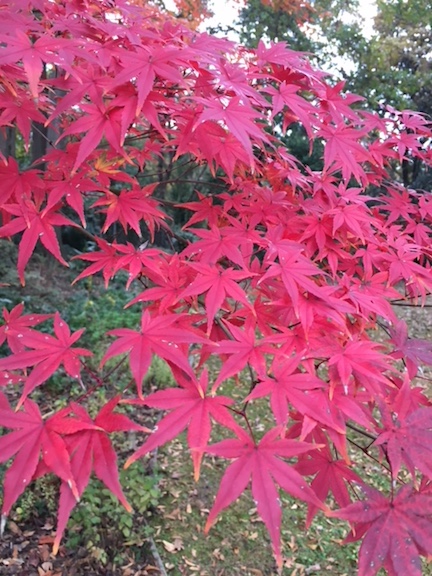
Now, when I call to my own grandchildren, “come and look at my burning bush!” They come and they ohh and ahh and I know that it’s not because they love the tree but because they love me. And, I hope that some day, they’ll be calling to their own children to come and look at the miracle of a maple tree in its autumn glory.
And I love the fact that this tree, somehow, connects us all, that generations that never knew one another have this shared experience of loving the sight of this tree.
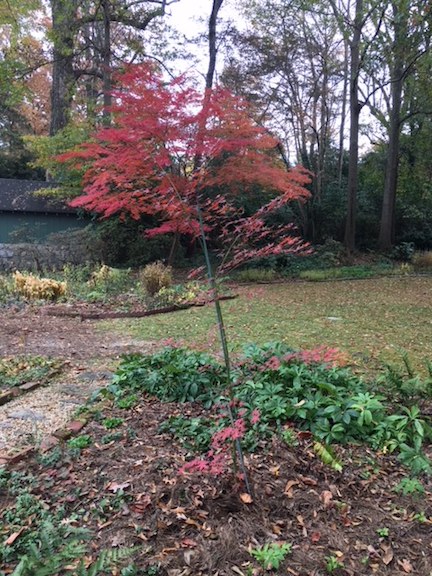
I can think of nothing better to pass on to my children and grandchildren than my mother’s sense of awe of the beauty of the natural world and a deep seated love of everything living and growing.
I hope that each of you has a wonderful day of love and gratitude. Happy Thanksgiving.