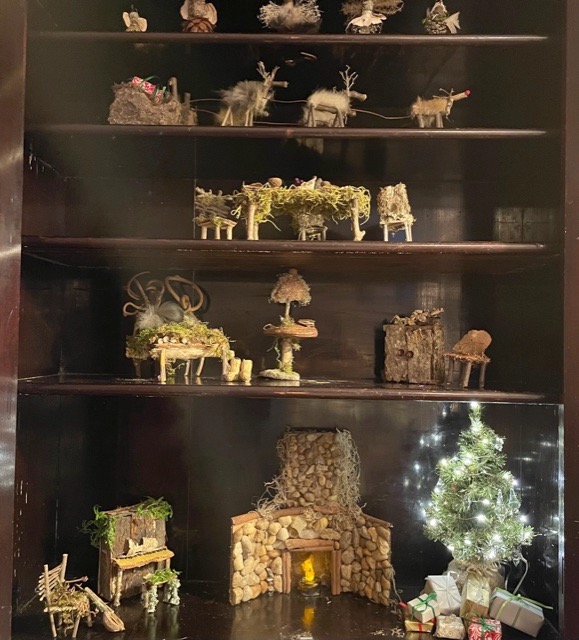
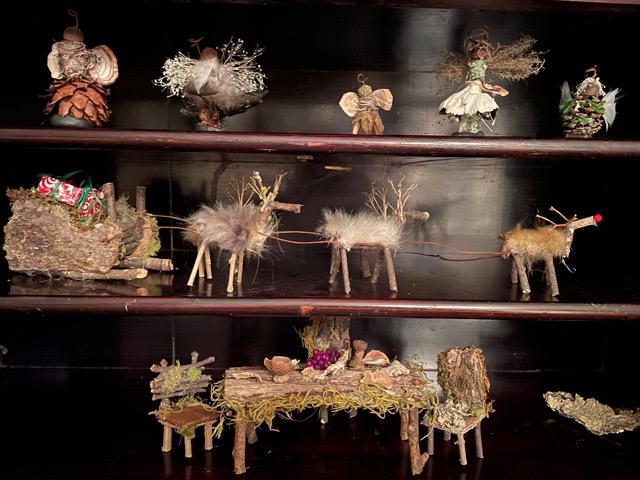
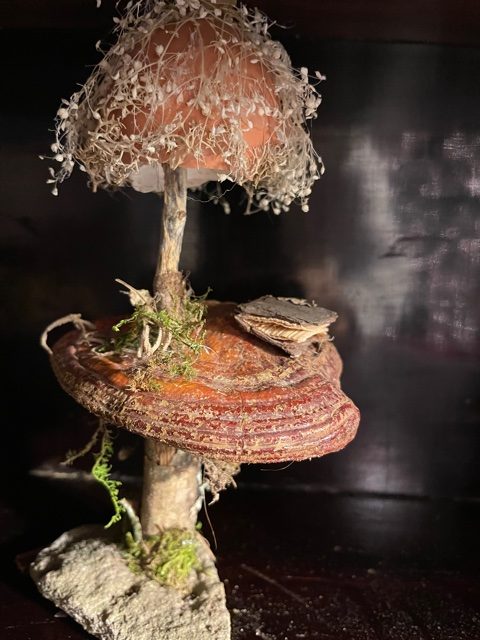
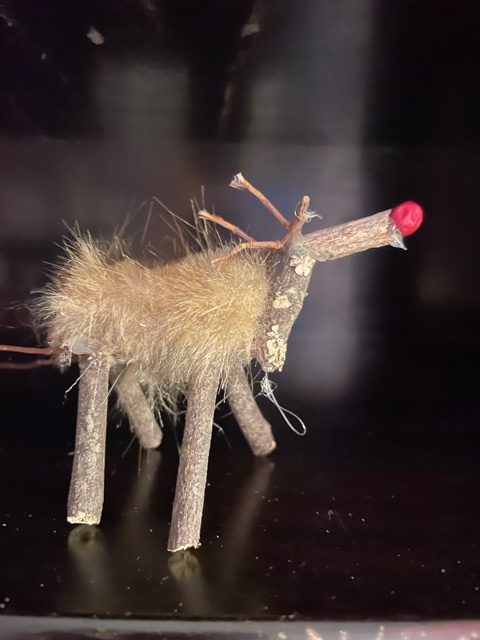
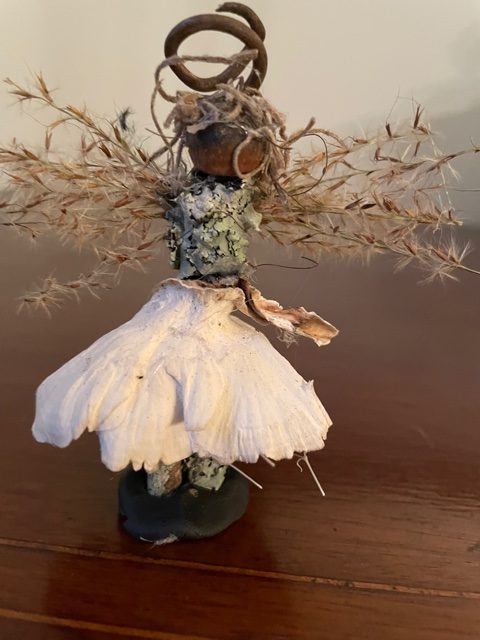
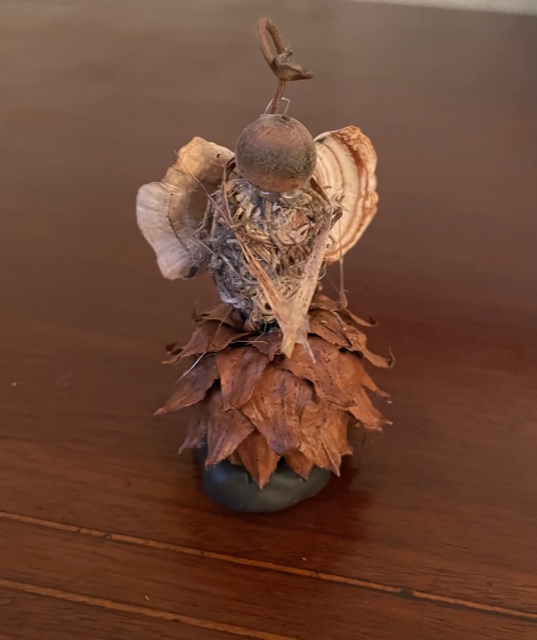
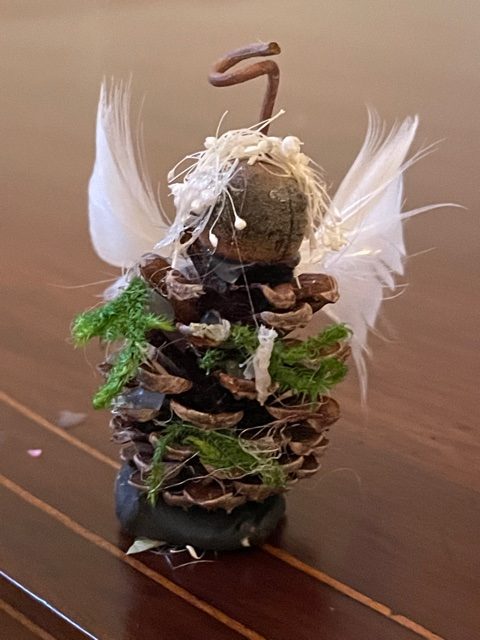
For reasons unknown even to myself, I am enthralled with the idea of creating tiny things out of woodland materials and making furniture and houses for the fairies. Let me hasten to add that although I’ve been making fairy homes and gardens for many years now, I have yet to actually see one of the “wee folk.”
But, while my own house still begs for decoration and there are still many presents left to make, buy and wrap, I ignore all the things that need to be done and scurry off to my art studio to spend hours making sure the fairy house is perfect for Christmas.
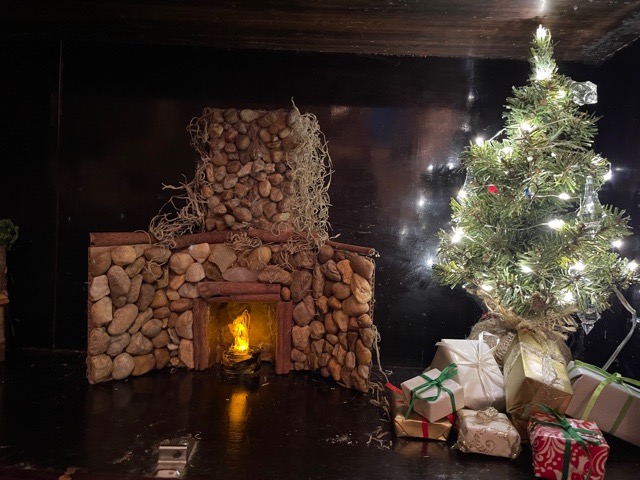
Although the fairies obviously always prefer to be outside, I move them indoors during the holidays so that my bigger friends and guests can enjoy their beautiful home as well. Think Architectural Digest on a scale of 1″ to 12″.
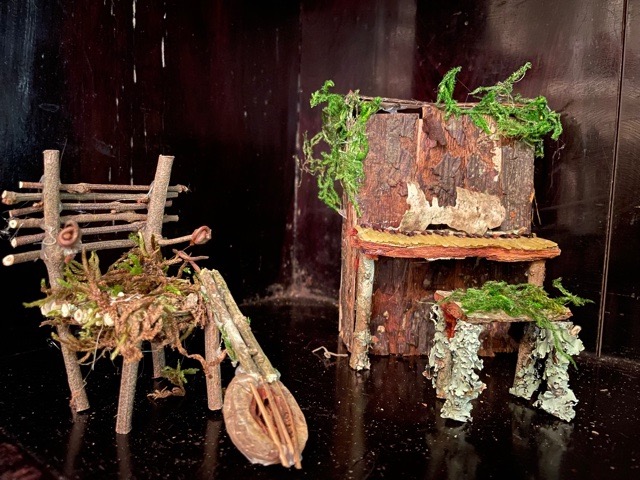
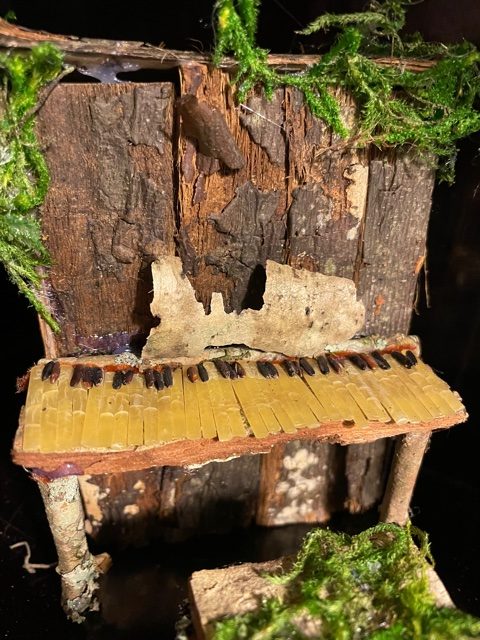
This year, as a special surprise for the wee ones, I made them a piano. The main frame is covered with bark and moss and was fairly straightforward. But the keyboard! what a challenge. I tried and discarded many things for the keys – stalks of grass, pebbles, bark, lichen…..none of it quite worked. The key (so to speak) was two spaghetti noodles, cut to length, and 27 grains of black rice. Using tweezers and a magnifying glass, I was able to satisfactorily reproduce a piano keyboard. I made a banjo too (out of a halved hickory nut) and I keep listening for them to make magical music but so far, it’s been a silent night.
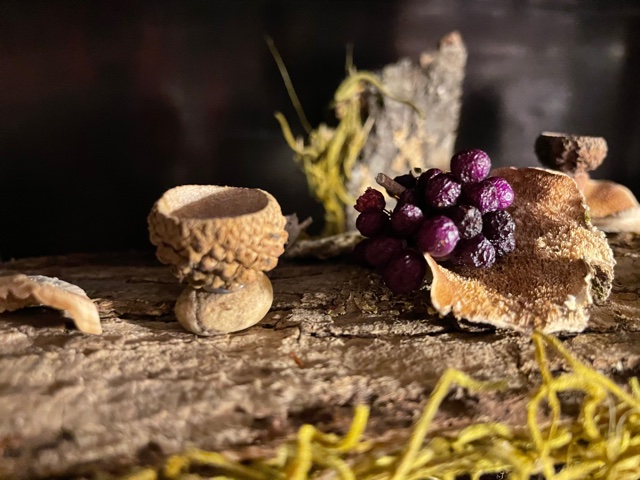
Upstairs is the dining room, with a table set with lichen plates and acorn cups. The entree this year is purple beauty berries. Yum!
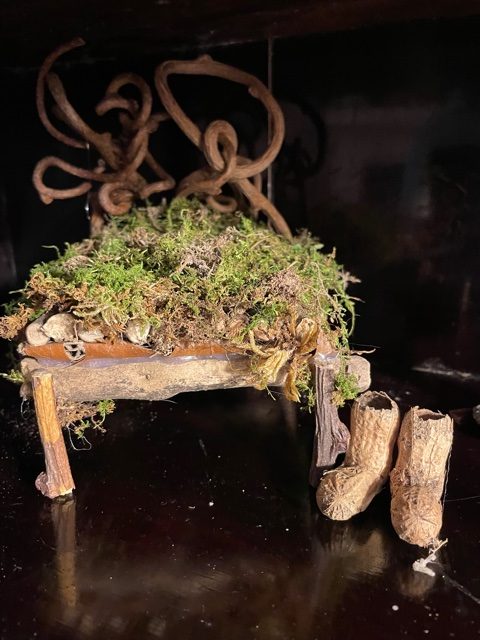
On the next floor up is the bedroom where one of the fairies has kicked off his peanut shell boots and stacked them neatly beside the bed. A half-read book is on the bedside table.
Up on the roof, Santa’s sleigh and 5 tiny reindeer wait for Christmas Eve. Of course Rudolph leads the way.
Overlooking the whole house, as they should, are the angels. These heavenly hosts stand guard, making sure that all within are safe and know that they are loved.
Whether they’re made of feathers and pinecones or something more heavenly, we can all use an angel watching over us. I hope that your own angels keep you safe and well loved throughout the holiday season and beyond.
The moon has been spectacular this month. Though I wasn’t fortunate enough to see the moon eclipse, I understand that it was a wonder to behold. I’m not the only fascinated with the winter sky. My friend, Donna Claus, who lives in the wilderness in Alaska wrote to tell me of her nocturnal adventures. I’ve posted parts of her letter here. Though this woman and I share many interests and passions – gardening, family, quilting – our world’s could not be more different. I know you’ll enjoy Donna’s letter – her life is fascinating and she’s a good writer!
Nov. 3 I have no idea what awakened me last night. It could have been one of the dogs curled around our bed. The window is still open to the cold air and the dogs hear what is going on outside, graciously keeping me posted. Lately there have been wolves talking in the night. The dogs get agitated. Their cousins are calling. In the night I go out with them just in case their cousins are close by trying to lure them to dinner.
Interestingly, I heard no wolves when we emerged from our cocoon of warmth into the chilly Alaska night. I was head down heading out, trying to get my parka hood up over my hair. I don’t put on clothes but simply put my parka on and it needs to cover well. I do that so I don’t fully awaken but the nylon down parka shell is cold wherever it touches so I am fully awakened by a thousand tiny needles of cold anyway. Evie, Bander and Mally are at my feet. They are big dogs, bent on protecting me from…… the Northern Lights. On a scale of 1- 10 they were probably 7 this night, which still overwhelms me. I have witnessed their majesty so often and in so many degrees of greatness that it is hard to get higher than 7, so my bar is high for them.
Finally the dogs bound off to do their thing and I stand with my hood thrown back to simply to stand still and gaze in awe. It is the official start of my winter, that first night when the lights make me stop and stare. They went on for hours which is unusual. I sat in a lawn chair and simply absorbed them while periodically going in for hot tea or to do a chore in the glorious peaceful deep of the night.
There was no need for a flashlight or headlamp. There were no clouds and the moon is almost new so it gives off little light as it skids across the lower quarter of the sky, The Milky Way glows, like trillions of tiny white winter decoration lights. I can see the space station, planets blinking red to green to white, and right over Orions Belt, a dancing purple Aurora. Then it speeds away, gaining life and soon the entire sky is filled with curtains of dancing light. Some people say you can hear them. I don’t know if you officially can, but it is sure easy to imagine that you can!!!!!
We have a bit of snow on the ground so it reflects the night sky up helping me to dance around, yelling and waving my hands delighted to be alive. There is nothing I enjoy more than seeing the canvas of the sky painted with the moving lights of winter.
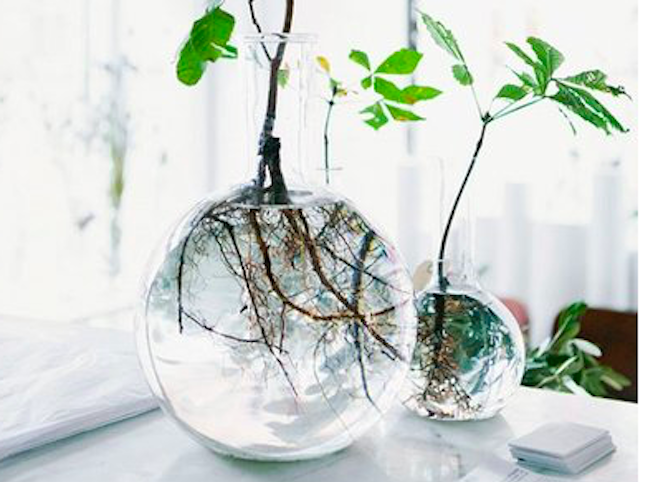
It all started when Jack and I were celebrating a special occasion at Kyma, a wonderful Greek restaurant close to where we live. While Jack was exclaiming over the really great food, I kept staring at the large glass vase which held a tree – with an infinite number of roots, all grown in water.
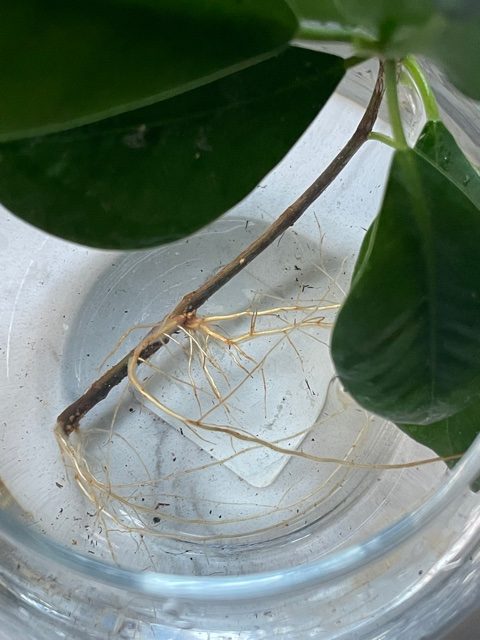
The roots looked like an intricate weaving, coiled and curled on each other. I don’t know how long the plant had been in the vase but it was there to stay – like a pear in a bottle, there was no way to extract the rootball through the narrow neck of the vase. But why would they want to? The tree looked healthy and the entire effect was beautiful.
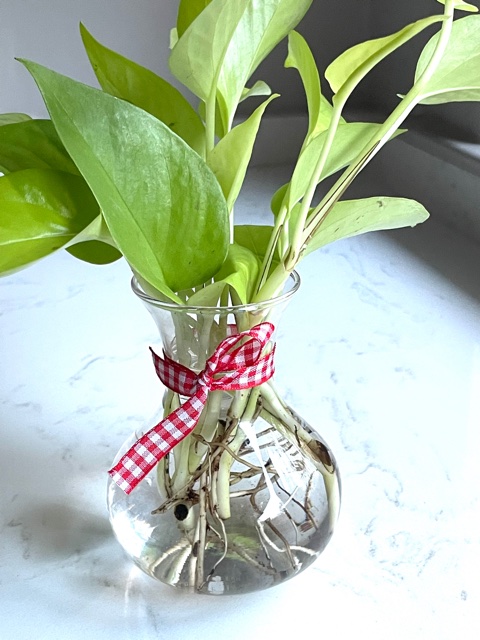
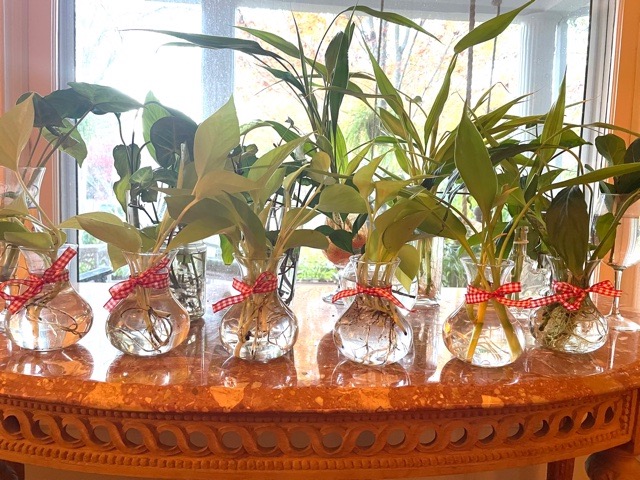
I decided right then and there that I would root plants in water in interesting vases to give to my friends for Christmas. What a great gift for someone who may not remember to consistently water a houseplant . No watering necessary! Changing water every couple of weeks is a good idea but not entirely necessary, and adding a drop of liquid fertilizer helps too but for the most part, this is a maintenance – free living gift. And, in the meantime, they make a truly delightful holiday decoration.
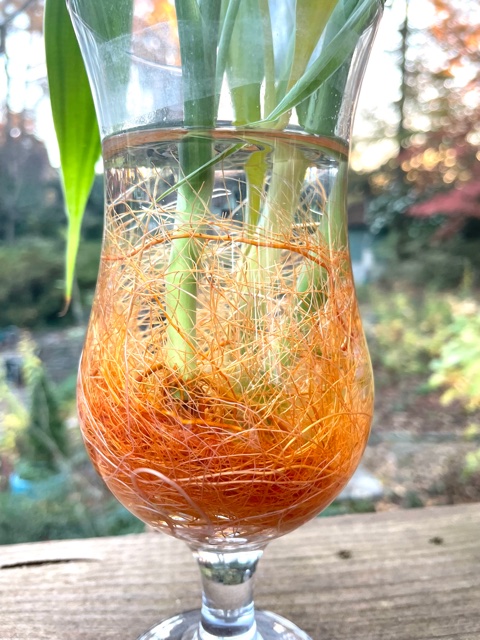
Most of us know that ivy and sweet potato vines will root readily in water but there are so many other plants that put out interesting – and sometimes colorful – roots. One of my favorite is lucky bamboo which produces an abundance of bright orange roots. Philodendrons, too, seem happy to live in water.
For many plants you can take a stem or leaf cutting and just put it in water and they will take root. This was a popular method of propagation for my grandmother’s generation and I can remember a shelf of jelly jars with rooting from all kinds of houseplants. It takes a while for the roots to start growing, I thought my stem from a fig tree would never root, but after several weeks, I saw a tiny hair emerge and from then on it continued to grow steadily.
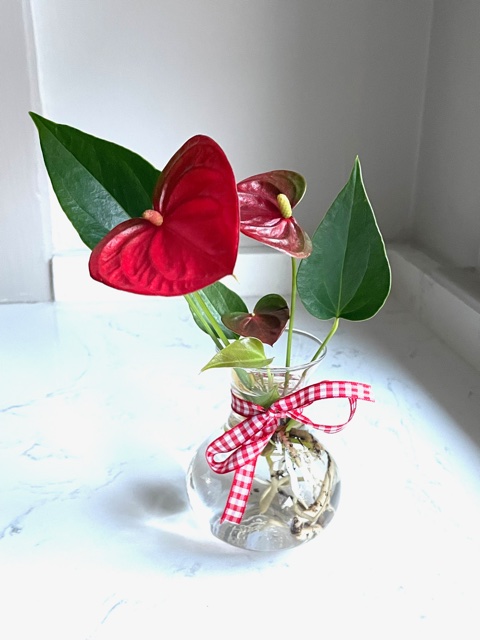
Being a little impatient – and knowing that Christmas is only a month away (how can that be!) I decided to hurry up the process by dividing both philodendron and anthurium plants, cleaning the roots the best I could and putting the divisions in water. This has worked great and my plants are all vased up and ready to give.
This isn’t exactly the science of hydroponics, but it’s the same idea. I’m wondering now if I can grow big, beautiful heads of lettuce in water under the grow lights. Or tomatoes! or…. wow, the possibilities seem endless. The idea of hydroponic farming is a far off dream. For today I’m glad to have my little row of living Christmas gifts and to be firmly rooted in the here and now.
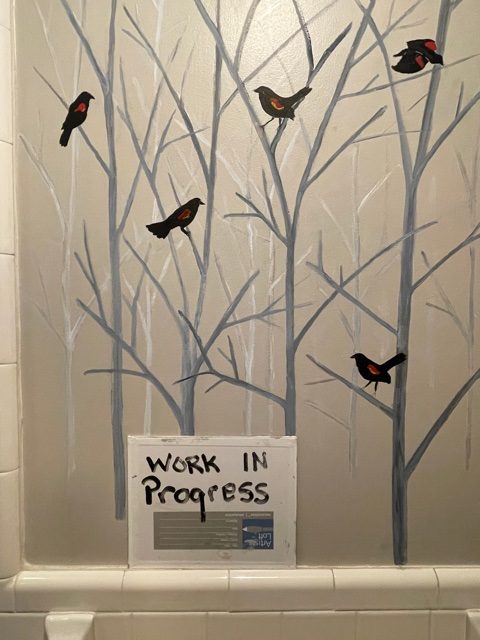
Jack and I recently gave our bathroom a much needed facelift. With the new look, I decided to paint a mural on one of the bathroom walls. I started, of course, while Jack was still at work. It’s just much easier to explain projects after I’ve started them instead of before. It was a multi-day project though, so before Jack came home from work that first day, I painted a sign which said “Work in Progress.”
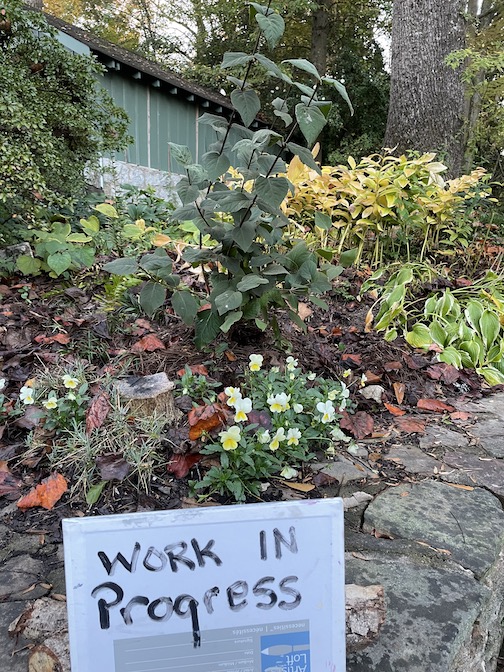
I think I need about a dozen of those signs. I look around the house and think, “Yep, I could use one of those signs here, or there, or there.” But where I should make a permanent “work in progress” sign is in the garden.
When I first began gardening, decades ago, someone told me that the only “finished garden is a dead garden.” Thankfully, I can say that my garden is definitely not finished!
Even now, in the middle of November, as I walk around the back garden I am amazed at the work in progress. Half the garden, it seems, is already getting ready for spring. English primrose, creeping blue phlox, grape hyacinth, and forget-me-nots are all putting out new growth, seemingly okay with the cold, wet months ahead. They do it every year, so I’m assuming they’re okay with what’s to come. For everything there is a season.
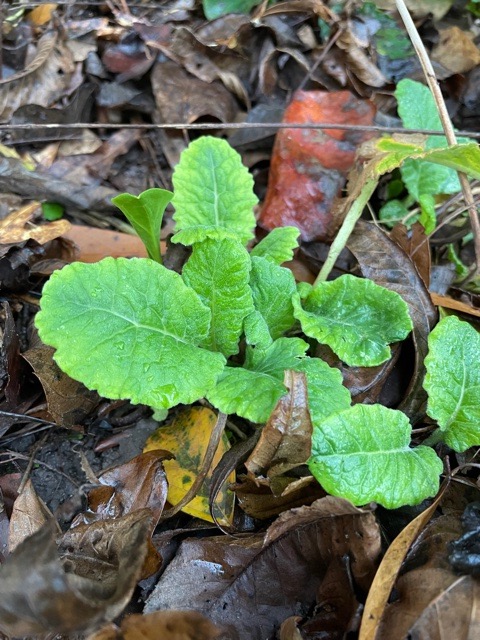
English yellow primrose, a gift from my Mom’s garden decades ago, is putting forth beautiful light green crinkly leaves.
I, too, am getting ready for spring, taking out a lot of plants, such as English Ivy, lenten rose and autumn fern, which have exceeded their allotted space and are crowding out other things. I’m dedicated to the idea of planting more natives for the native pollinators so I’m pulling out aggressive, invasive plants that offer little use to the ecosystem, making room for plants that serve an environmental purpose.
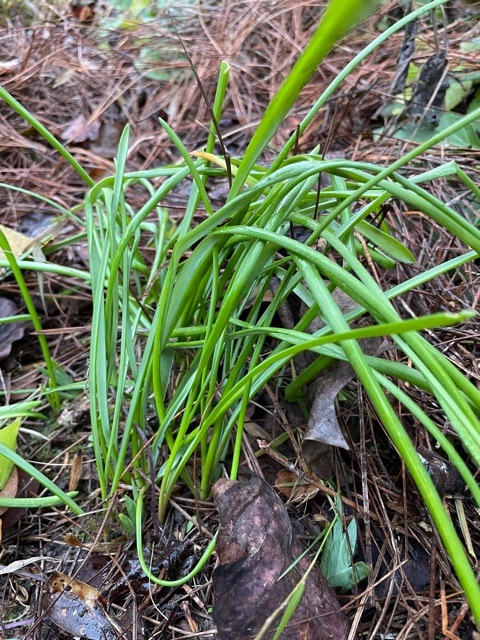
Grape hyacinth leaves are all ready for spring!
I’m happy that I live in a place where I can get out and garden almost all year long, though I, too, am aware of the wet and cold months ahead. But today the sun is glorious, the sky is an indescribable blue and the air is crisp. Today, I think I’ll hang the “work in progress” sign on the garden gate. Better yet, I’ll hang it around my neck!
For months now, I’ve been wondering what in the world I was going to do with all the houseplants that have spent the summer on the porch. They have multiplied prodigiously and have grown enormously, the result being that the few sunny windowsills in the house will not come close to providing enough room for these tender plants that can’t take the cold weather.
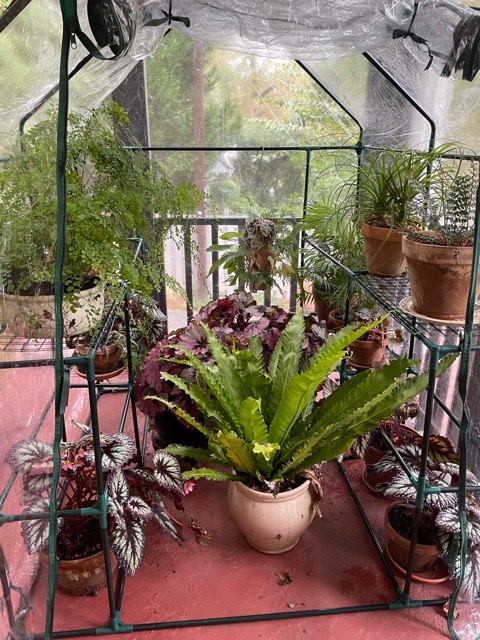
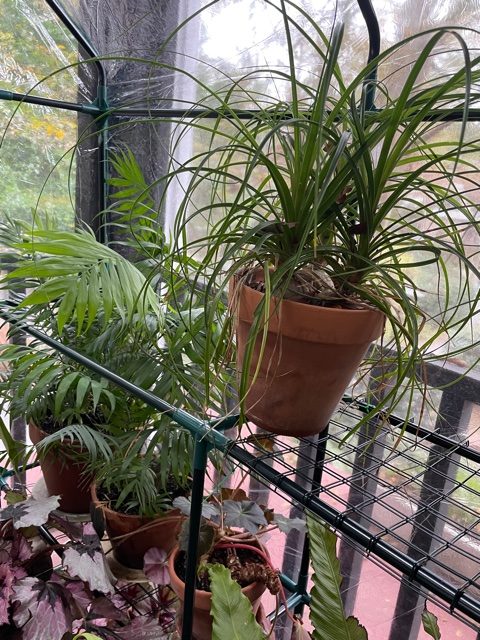
My solution was to build a tiny little plastic encased greenhouse for them. I put it on the side of the porch so I could just roll, drag or push the heavy pots into some semblance of warmth and protection.
I was going to build it from scratch but my sister convinced me that kits from Amazon were inexpensive and “easy” to put together. And how right she was! For $75 and about 3 hours of my time, I put together my mini-greenhouse. Problem is, I’m not sure it was worth it because I don’t know if it will provide enough protection to keep the plants alive. (But, if you asked Jack, it was worth $75 to keep me busy and out of mischief for 3 hours !)
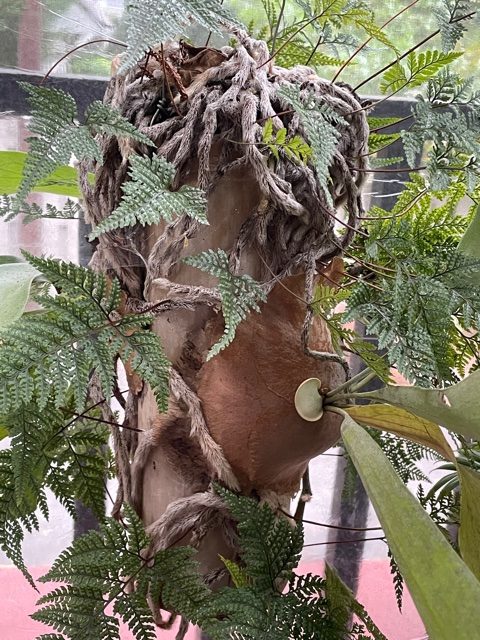
I’ve never known where to hang this board with stag horn and rabbit foot ferns on it. My new greenhouse provides the perfect spot.
What I did not anticipate was how much I love this little greenhouse. It looks downright cozy and so far, the plants look really happy. (Of course the temps haven’t dropped below 45 yet!). All the pots are crammed in there pretty close together but some of them actually look better than they did spread out across the porch. Maybe some plants like to be crowded?
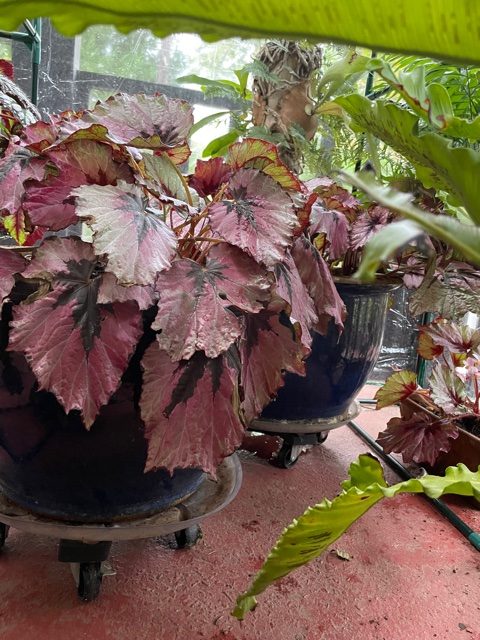
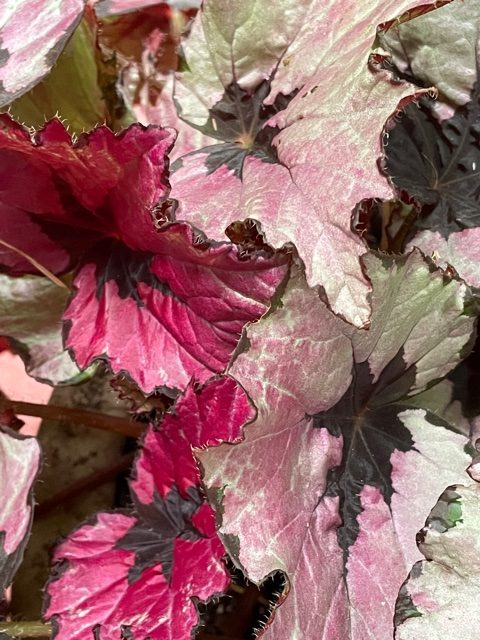
Many of my potted plants are begonias. Some I inherited, some I bought because I can’t resist their deeply textured, beautifully colored leaves. Some are in pots so big I have them on rollers, others are in “nursery” pots of the newly divided. The tiny palm and ponytail plants that I bought in two inch pots several years ago are not two feet tall and happy in their 8 inch pots.
It may not be the greenhouse of my dreams but it is toasty and charming and makes me happy. I have to squeeze in between the ferns and the begonias, but once inside, I’m glad to be part of the crowd.
As temperatures finally begin to drop and fall is in the air, the trees are responding with their annual display of vibrant colors. Dogwood is turning that beautiful, subtle dark maroon with accents of bright red berries. Tulip poplar and oaks are sporting golden yellow while the maples are beginning to show their brilliant orange.
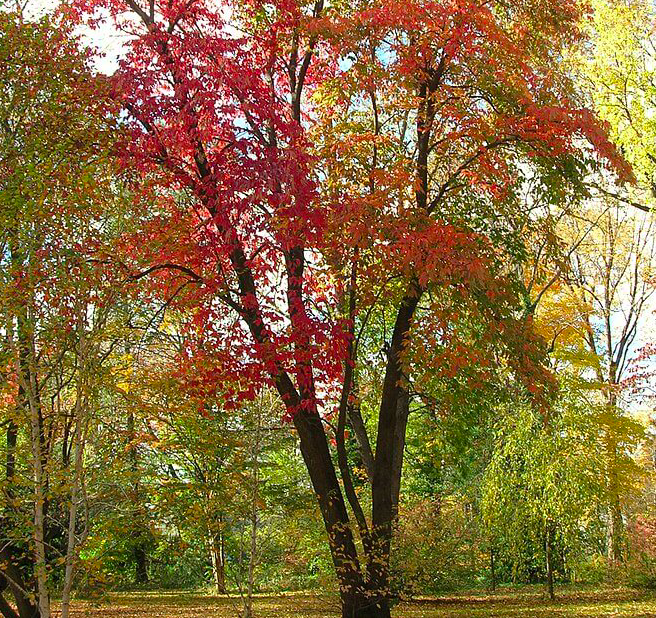
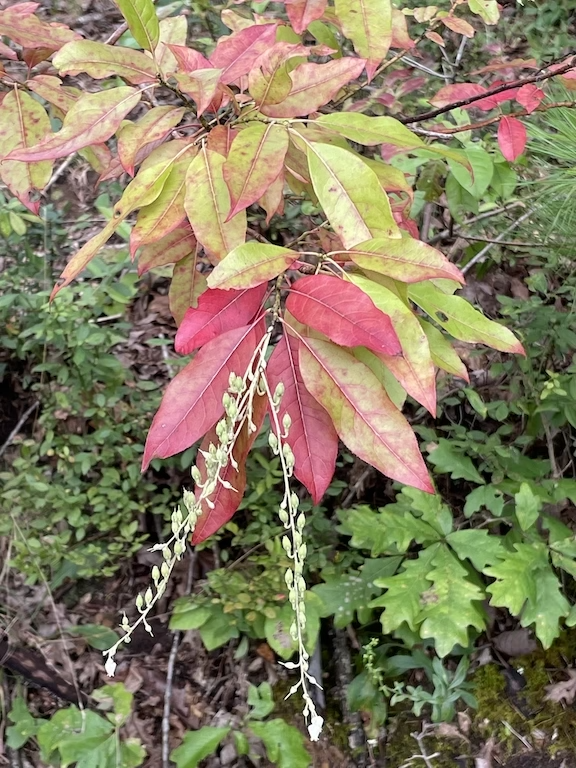
American sourwood
Of all the fall trees, though, I perhaps appreciate the sourwood most of all. One of the first to show color, you can pick out a sourwood tree from a forest of green at quite a distance.
This is an all-season tree. In addition to the stunning fall foliage, it has beautiful delicate flowers in mid-summer, interesting bark and a great silhouette during the winter months and light yellow-green leaves in spring.
Sourwood (also known as sorrell tree) is so named because of the acrid or sour taste of the leaves. They’re apparently edible, though I’ve never tasted one. Wild crafters and foragers will use them as flavoring or steep them in hot water to make tea. Native Americans used the leaves as both flavoring and medicine.
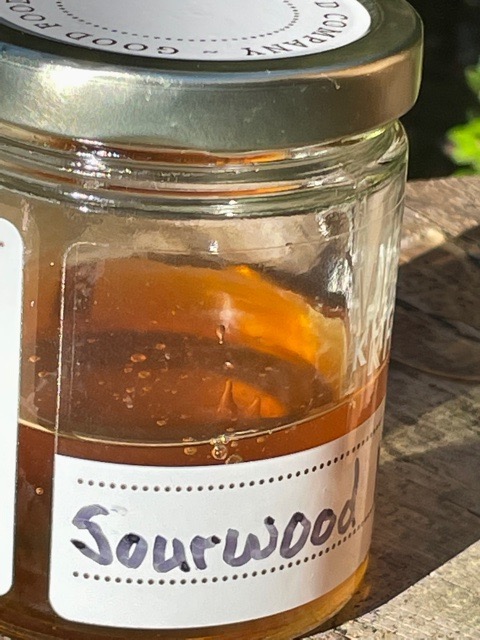
Perhaps sourwood is best known for the honey that bees make from the flower nectar. The blossoms last only three weeks during summer but bee keepers and probably the bees too celebrate this season. The honey made from sourwood blossoms is considered some of the finest. Sourwood honey won three out of the last six world honey championships.
Sourwood honey is a very light amber color and, according to the honey experts, has a “soft anise and spice” flavor. Reading about different honey flavors is somewhat like reading descriptions of wines. Tulip poplar is “dark, bold and minerally.”
Sourwood trees are understory trees and provide an important layer in an ecosystem. They are native from Pennsylvania south to northern Florida and west to Illinois. But, like many of our native plants, sourwood populations are declining. The trees have been weakened by periodic droughts and extreme temperatures and many have been lost due to development.
Because it is such a lovely tree, you should plant one in your yard. It likes full sun but will do fine in partial shade. It will benefit you – and nature!
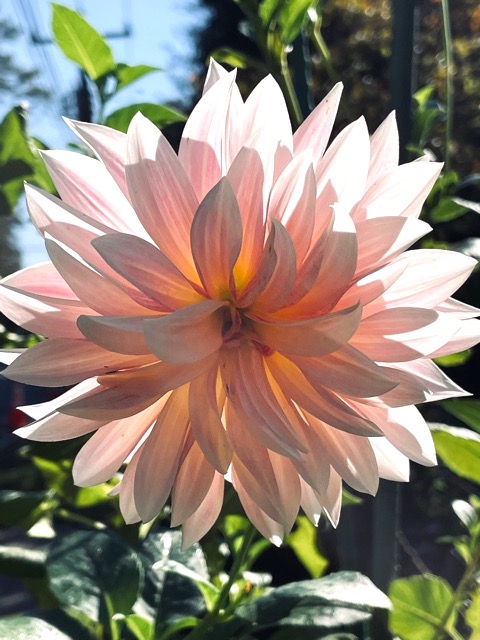
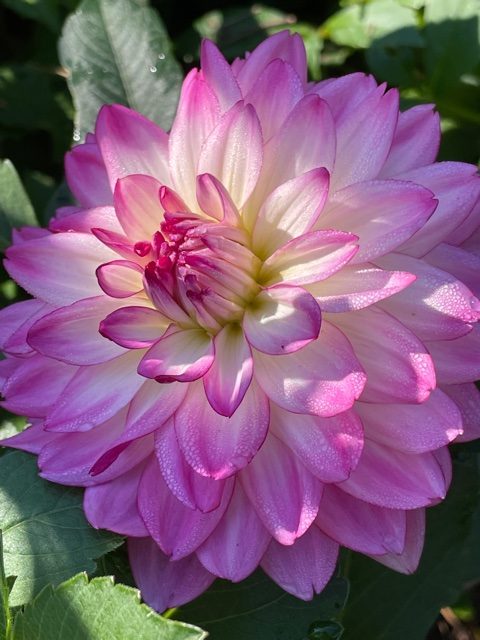
I’ve been waiting six months for my dahlias to bloom and finally! hallelujah! they are putting forth the most incredibly beautiful flowers in the garden. I don’t know why they took so long to bloom. Maybe because it was an unusually wet summer? Maybe I had them planted too close to other plants? I’ve never grown dahlias before so I’m not sure.
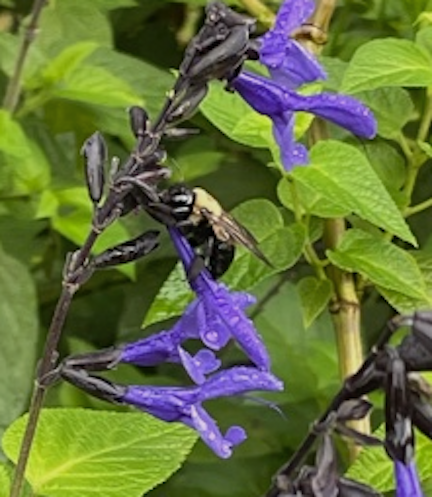
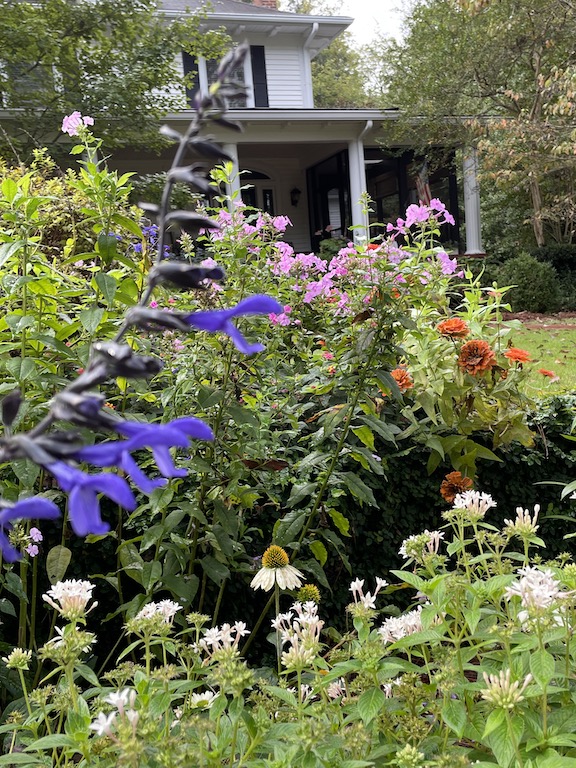
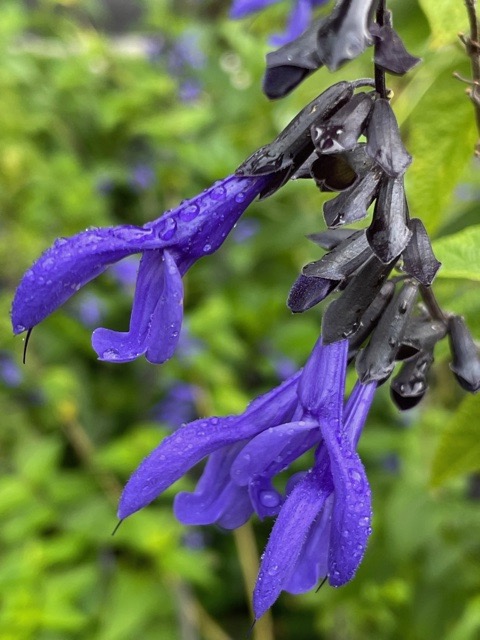
But unfortunately, after waiting all this time, I’m finding out the my double-flowered beauties are just another pretty face in the garden. I spend a lot of time gardening in the front where the dahlias are planted so I have ample opportunities to see which plants the pollinators love (black and blue salvia is the TOP winner.)
I watched carefully as the dahlias came into bloom and nary a single insect landed on the blossoms. Of course not! There’s no pollen in most of them and the others are packed so full of petals that the bees can’t find the pollen. Remember that old commercial about the hamburgers, when the guy says, “where’s the beef?” That’s what I imagine the bees are saying “where’s the nectar?”
This does not mean that all dahlias are completely useless to pollinators. It just means that the double varieties that I planted in a less-enlightened time of my life (last spring) provide no value to the ecosystem. Open centered dahlias, with simpler flowers are actually fairly decent as pollinator plants.
This dahlia is a lot loess complex and is more available to pollinators.
Most of us by now know that by far the best pollinator plants for native insects are native plants. Not only can the pollinators “find the beef,” but also the plants and insects also evolved together so that the insects instantly recognize them as useful plants.
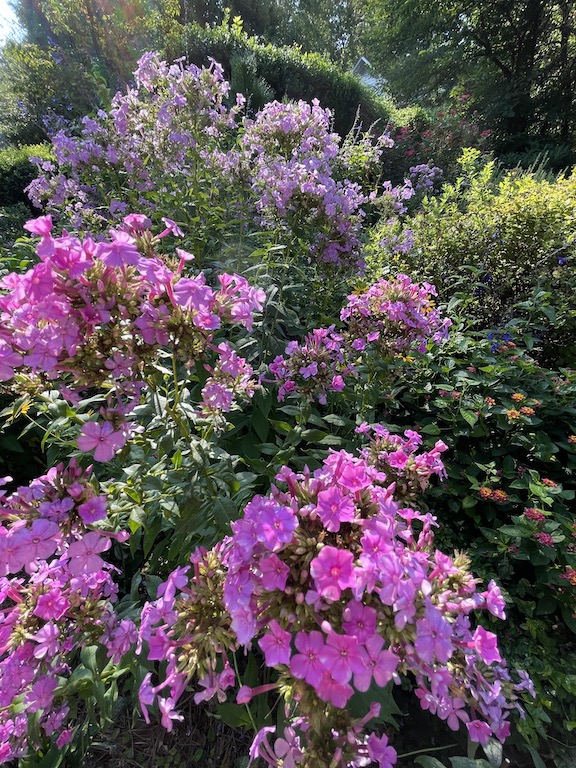
You’d have a hard time convincing me that this glorious phlox (which pollinators LOVE) is less beautiful than the dahlias.
Does this mean that our beloved ornamental plants are of no value? No of course not. I value my dahlias simply for their beauty. But I also have to take into consideration the carrying capacity of my yard and how many plants I can support when considering space, water and mostly my own time and energy.
I think it more important to choose plants that provide both beauty and value to nature rather than to just plant more pretty faces. We are at a juncture where we all need to help nature in whatever we can. By providing a diversity of flowers useful to pollinators, I feel that I am making a contribution to the greater biodiversity of the planet, which I consider a worthy goal.
(note: I’m currently scheduling spring speaking engagements. If your group or organization is interested in having someone speak very enthusiastically about the wildflowers, email me at Naturebasedblog@gmail.com. I love sharing my passion for native plants. )
After a long, hot, humid summer, I’m sometimes tempted just to shut down the garden, cut everything back and mulch over the whole mess. But when I venture out, I realize just how important my fall garden is to late pollinators.
Natives, along with cultivated flowers such as pentas and zinnias provide much needed nectar and pollen for late season pollinators.
Although it’s critical to provide for native pollinators during the year, it’s particularly important during the shoulder seasons of early spring and late fall when plants are not as profuse as they are in summer.
When I took time to look I realized that there were still a lot of things in bloom and that most of them were covered with bees and butterflies. My number one, very favorite pollinator plant is the Black and Blue salvia. From a strictly aesthetic point of view it has a few drawbacks, mainly that it’s big and gangly and has a hard time standing up straight (sounds like my 14 year old grandson. Just kidding.) But the pollinators absolutely don’t care and it is dripping with bees and wasps and hummingbirds and butterflies as long as it’s in bloom, which is a long time! This began blooming in May and is still going strong. I highly recommend it!
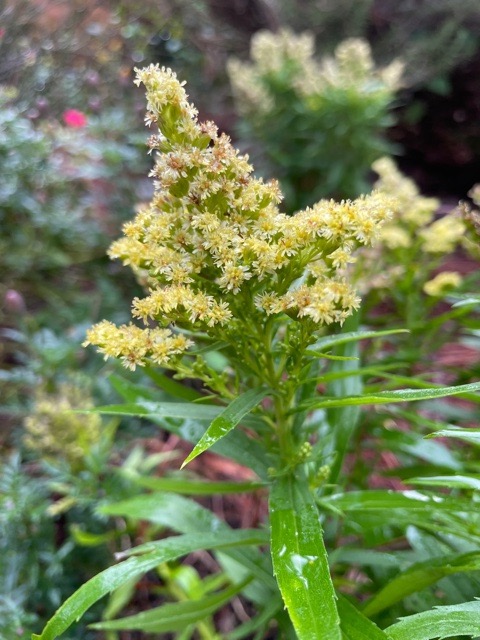
Goldenrods, too, are pollinator magnets. I planted some miniatures this year, called ‘Little Lemons’ and the bees were on it as I was planting it. I hope these new plants will grow and multiply and fill a part of my yard with golden wonder.
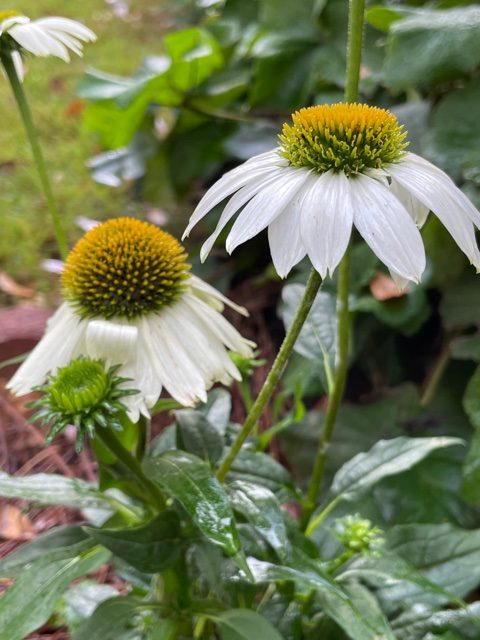
I had to replace my coneflowers and put the new ones in a different spot as my old Echinacea developed a bacteria called yellow aster which causes the blooms to be distorted and sprout green ray flowers. There’s nothing to do about it except remove the affected plants and start over in fresh soil somewhere else.
According to a Mt. Cuba Center study, the cultivar “Fragrant Angel” attracted more pollinators than any other cultivar or straight Echinacea species.
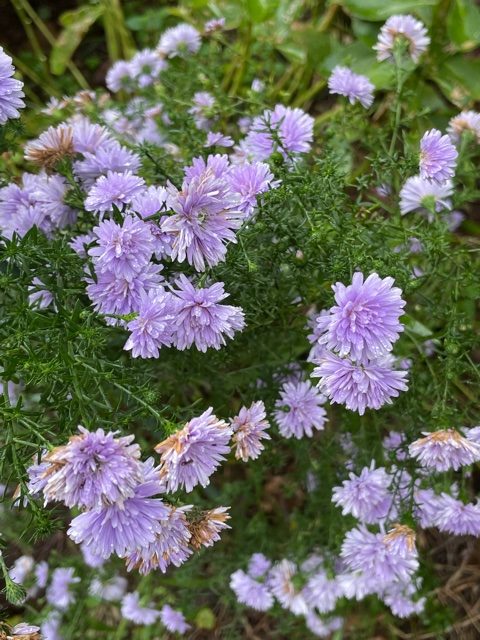
Another happy autumn pollinator plant is aster. These are readily available at nurseries. Asters are particularly important as larval food for the silvery checkerspot butterfly but also provide nectar and pollen for many species of native bees, wasps and flies.
So, don’t give up on your garden yet. Leave the seeds on the stalk for the birds this winter and leave every last available blossom for the pollinators. They need it!
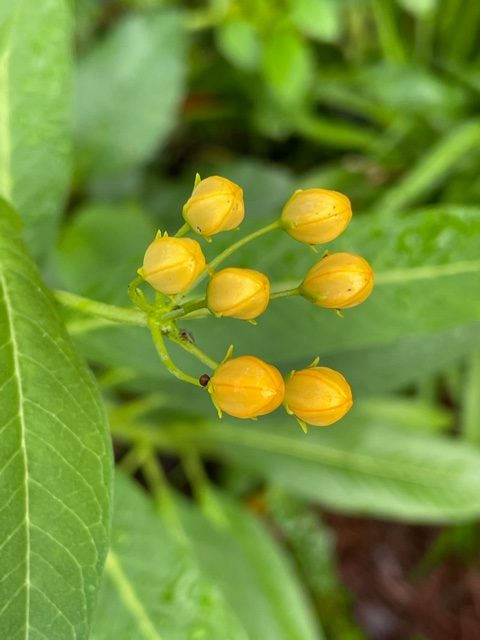
Milkweed seeds leftover from last year germinated and began to grow midsummer. They have just now budded up. Fingers crossed for blossoms before frost.
Though there are many cultivated garden plants that are good for pollinators in the fall, such as lantana, zinnias and sedum, the native plants are much more likely to attract native pollinators – always a good thing for nature!
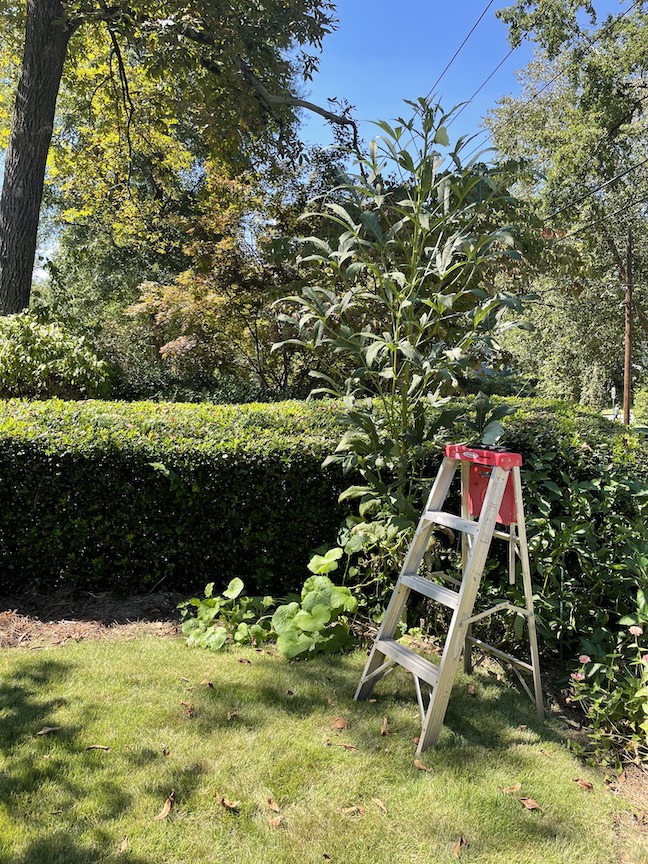
Well, to be perfectly precise, as of this afternoon, my okra plant is exactly 9′ 3″ tall – but check in later today for an update because this sucker continues to grow and tower over everything else in the garden.
This is a four foot ladder next to my okra “tree”
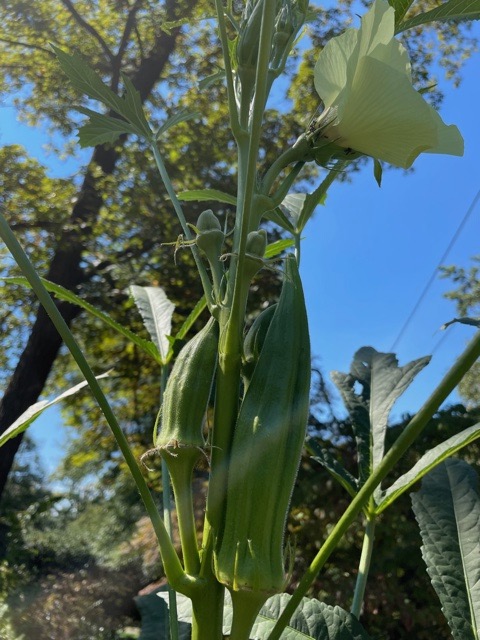
I’ve had tall okra in the past but this has exceeded my expectations – by several feet. Okra is one of those plants that gets a slow start in the spring – it LOVES hot weather and warm soils. But, once it begins to grow, apparently nothing but frost will stop it. I’ll have to admit, there are days that I pray for frost.
It is definitely a conversation starter in our neighborhood. A lot of people stop and stare and ask what in the world is it? It’s way too tall now for normal people to see the very attractive bloom and the delicious pods. So people just see this tree-like structure growing in the corner of the yard and think what-the-heck? It doesn’t really look like a tree, it’s just the same size.
Needless to say, this has been a prolific plant. It has matched in fruit what it has attained in height. We have had a lot of okra this summer – roasted, in stews, fried with cornmeal, in little pancakes – we’ve had it all. Fortunately, my husband and I are both native Southerners (actually native Atlantans) who grew up eating Southern stapes such as grits and okra.
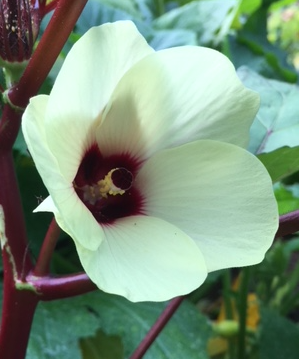
The okra blossom is actually beautiful – if you’re tall enough to see it.
Okra is in the mallow family and the blossom look like hibiscus and cotton. All three plants are closely related. Okra probably came to the United States from Ethiopia where it has been cultivated since 2000 BC. Okra is muscilaginous (i.e. a little slimy) and makes a good thickening agent. For this reason, it was often used in stews. The Bantu word for “okra” is ochingombo. Stew with okra in it eventually came to be known as gumbo.
I’d love to stay and regale you with stories about okra but I have to go. Something is suddenly blocking out the sun. I think it might be my okra tree.
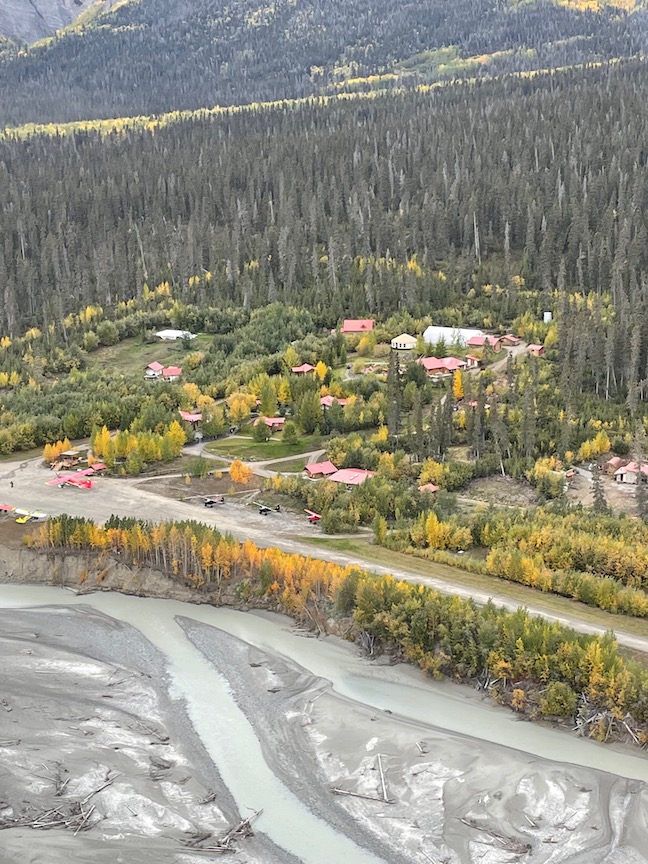
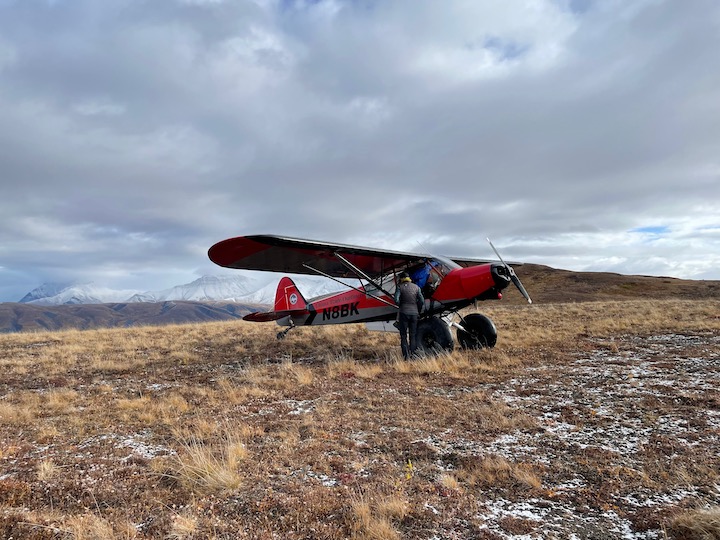
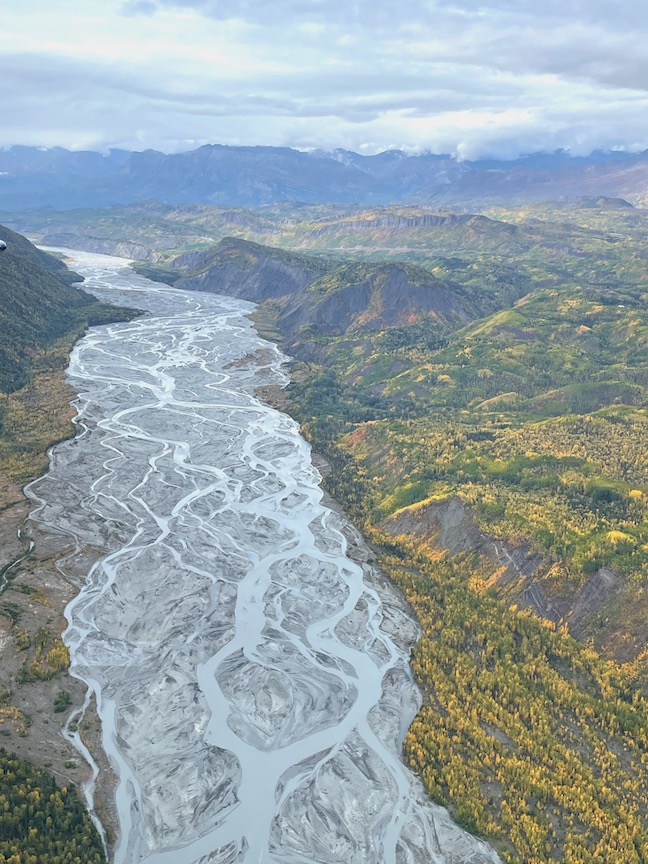
Imagine, if you can, a woman living in the wilderness of Alaska at a place so remote that the only possible way to get there is by bush plane. Imagine this place and you would probably conjure up images of bleak glaciers and dark evergreen forests, of glaciated braided rivers and of tundra vast enough to boggle the mind. And your conjuring would be, up to a certain point, quite accurate for the wilderness of the Wrangall St. Elias National Park is all of that.
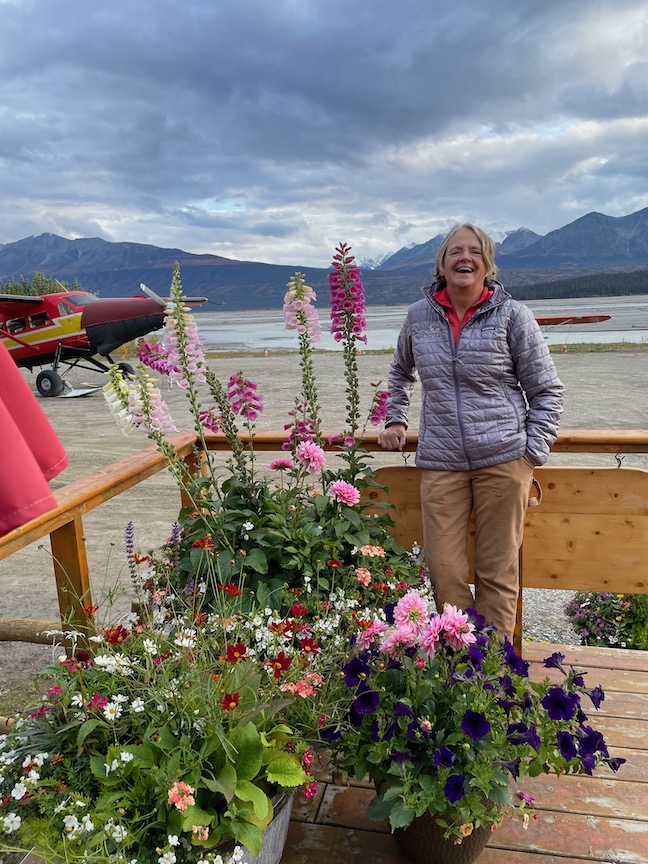
But this woman of the wilderness is also a gardener which means that in addition to the unbelievable expanse of wild, achingly beautiful land, there is also a tiny spot of gentle beauty that feels like home.
Ultima Thule Lodge is in the Wrangall St. Elias National Park and is accessible only by plane.
Donna Claus is a remarkable woman. She and her husband, Paul, an Alaska bush pilot and climber of great renown, created a lodge in the wilderness so that ordinary people, like me, a soft and green product of the sweet and sultry American South, could come and safely experience for a few days what wilderness really feels like. Visiting with Donna and talking to her was a stark and wonderful reminder of why we garden.
Before you begin to pigeonhole Donna as just a “friendly innkeeper” let me add a few nuggets of information that I mined from her in the precious few days I knew her. She’s a pilot. And a climber. And explorer. I don’t even know a fraction of Donna’s life adventures but when I say this is a tough woman, I say it with a great degree of certainty.
When I sat and talked with Donna, we quickly found the common ground of interest in gardening. I asked her why she gardened when there was so much natural beauty around and she answered, “The wilderness can be overwhelming. You fly hundreds of miles and see all kinds of things every day but the sheer magnitude of it all can make you feel pretty insignificant. So when the guests get back from a day of flying and hiking on glaciers, I want them to feel welcomed and at home.”
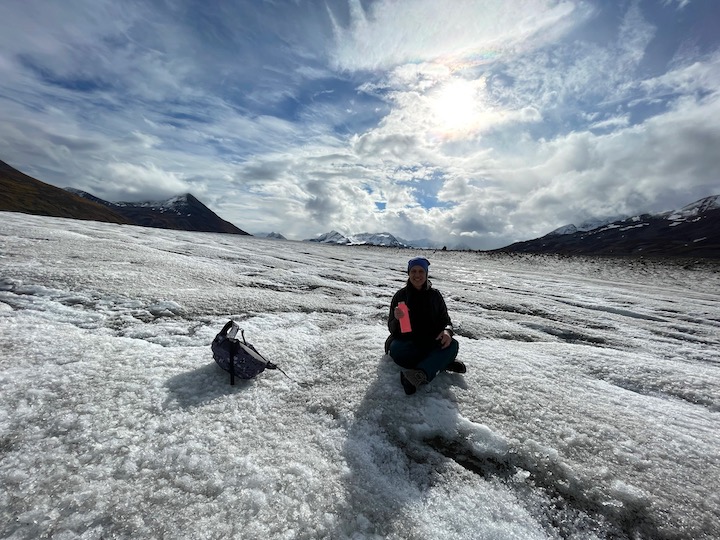
Having a sip of tea on a glacier. By far the most remote place I’ve ever been.
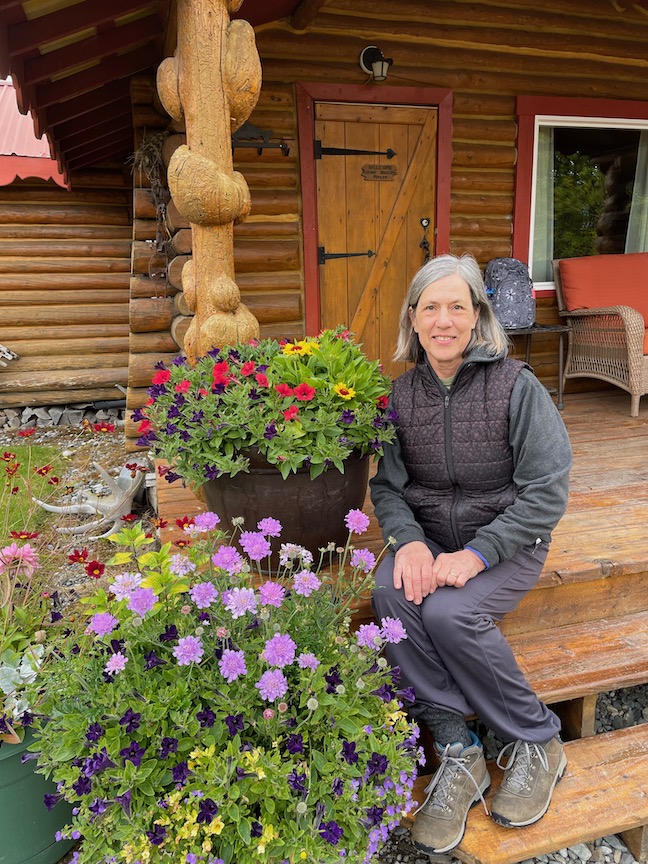
Sitting on the front porch of our cabin with flowers that made me feel right at home.
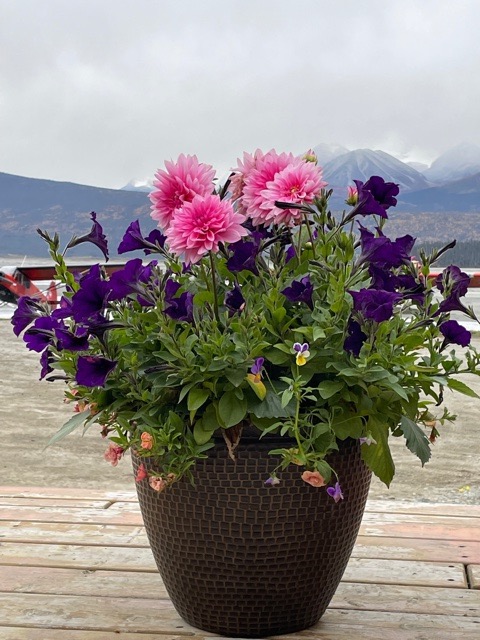
And walking up to the lodge (Called Ultima Thule, which means “beyond the end of the known world”) after a day of adventuring in the wild, I realized how successful Donna had been – and how important her vision was. When I saw old familiar friends in the pots of colorful flowers, I began to settle back down into a more familiar perspective. A dahlia blossom is both stunningly beautiful and comforting at the same time. It looks like home. It is beauty that I can appreciate without over – extending my senses.
I’m sure that doing technical climbs to summit mountaintops and walking 30 hours UNDER a glacier to get back to civilization is incredibly difficult but after listening to Donna describe what it’s like to garden at the edge of the world, I suspect that gardening must rank among her greatest accomplishments.
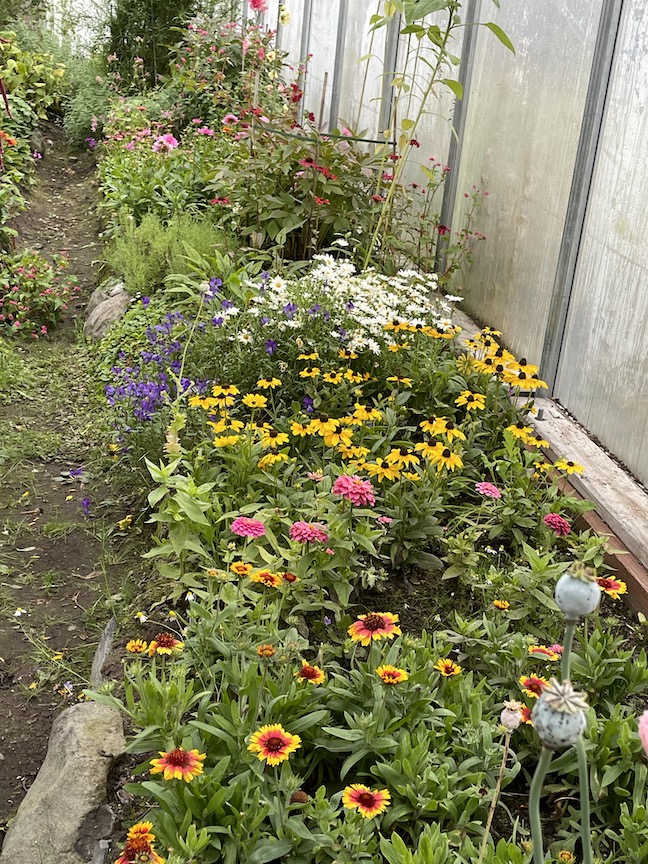
Imagine this: Temperatures that can dip as low as 78 degrees BELOW zero. Trying to garden in a place where every single bit of equipment, from the trowels to the seeds to the bulldozers, have to be brought in by plane. Months of wind and dust that can leave 1/8 to 1/4 an inch of silt on every surface every day. Seeing “terminator dust,” the first snows on the surrounding mountaintops that signal that winter is just around the corner. And then composting everything. Everything. She starts the garden from scratch every year since nothing survives the winters. Let me hasten to add that Donna’s garden is not small. She says that every year she plants approximately 20,000 plants in pots and beds.
By mid-September, Donna’s greenhouses are full of healthy and enthusiastic plants. In another week or two, as terminator dust creeps down the mountains, all of this will be composted.
Along with the many challenges, though, Donna does have a few advantages. For one thing, she gets amazingly rich topsoil straight from the mountainside behind the lodge. And she has sunshine. Lots and lots and lots of sunshine during the summer. She says that the rate of growth is astonishing. Things will double in size overnight.
The Chitina River has changed course so many times, Donna and Paul have had to move everything – every building, every bit of equipment and all the garden – three times!
Being in Alaska and talking to Donna about gardening was a surreal experience because everything was so different and somehow seemed magnified many times over. It is not a place where I could live or garden for I don’t have the skills for either one. But as different as Donna and I are, we found instant companionship and friendship based on our shared love of digging in the dirt. And this is why I garden, not only to plant things that are beautiful but because I love being part of a community of people with this shared passion, wherever their dirt might be.