Gardening at the edge of the world

Imagine, if you can, a woman living in the wilderness of Alaska at a place so remote that the only possible way to get there is by bush plane. Imagine this place and you would probably conjure up images of bleak glaciers and dark evergreen forests, of glaciated braided rivers and of tundra vast enough to boggle the mind. And your conjuring would be, up to a certain point, quite accurate for the wilderness of the Wrangall St. Elias National Park is all of that.

But this woman of the wilderness is also a gardener which means that in addition to the unbelievable expanse of wild, achingly beautiful land, there is also a tiny spot of gentle beauty that feels like home.
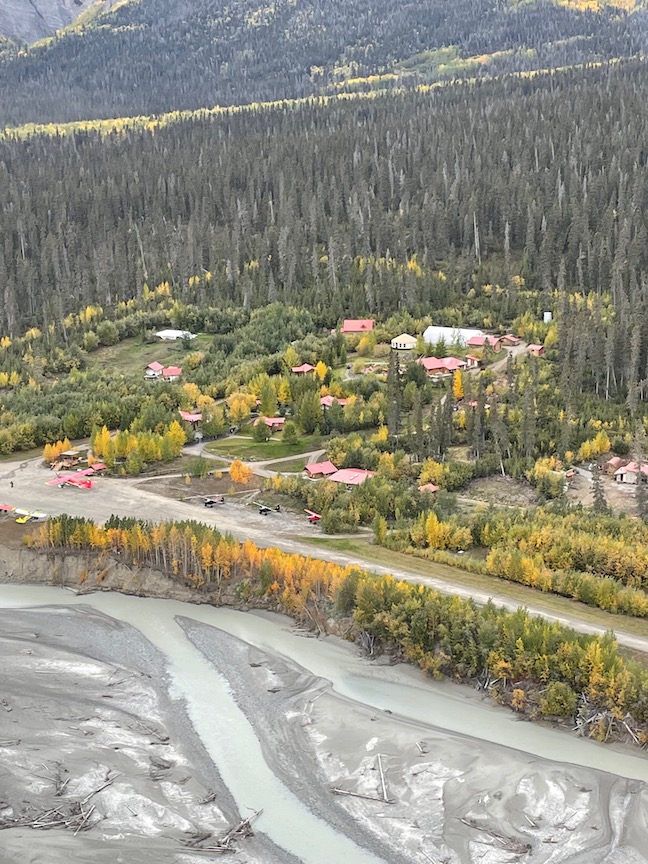
Ultima Thule Lodge is in the Wrangall St. Elias National Park and is accessible only by plane.

Donna Claus is a remarkable woman. She and her husband, Paul, an Alaska bush pilot and climber of great renown, created a lodge in the wilderness so that ordinary people, like me, a soft and green product of the sweet and sultry American South, could come and safely experience for a few days what wilderness really feels like. Visiting with Donna and talking to her was a stark and wonderful reminder of why we garden.
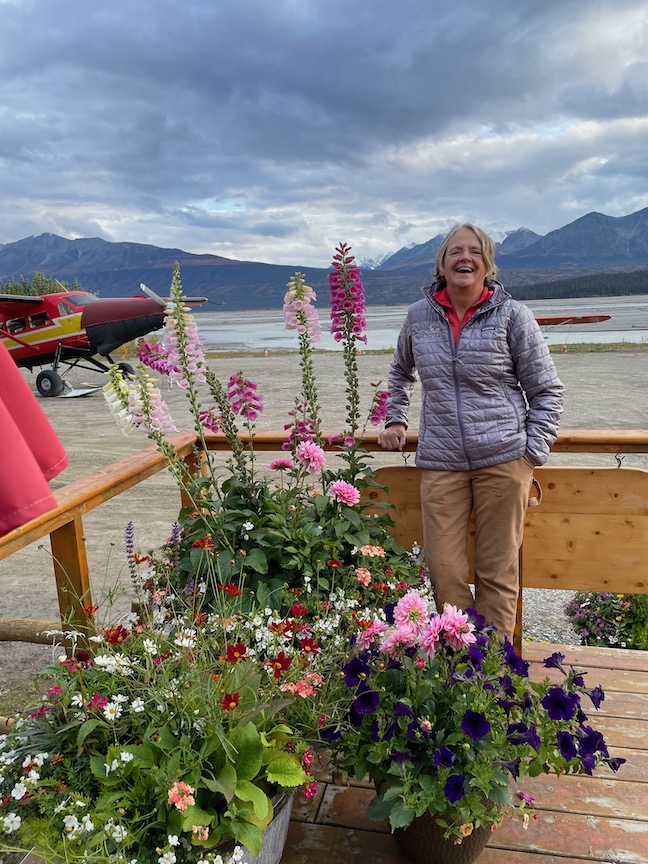
Before you begin to pigeonhole Donna as just a “friendly innkeeper” let me add a few nuggets of information that I mined from her in the precious few days I knew her. She’s a pilot. And a climber. And explorer. I don’t even know a fraction of Donna’s life adventures but when I say this is a tough woman, I say it with a great degree of certainty.

When I sat and talked with Donna, we quickly found the common ground of interest in gardening. I asked her why she gardened when there was so much natural beauty around and she answered, “The wilderness can be overwhelming. You fly hundreds of miles and see all kinds of things every day but the sheer magnitude of it all can make you feel pretty insignificant. So when the guests get back from a day of flying and hiking on glaciers, I want them to feel welcomed and at home.”
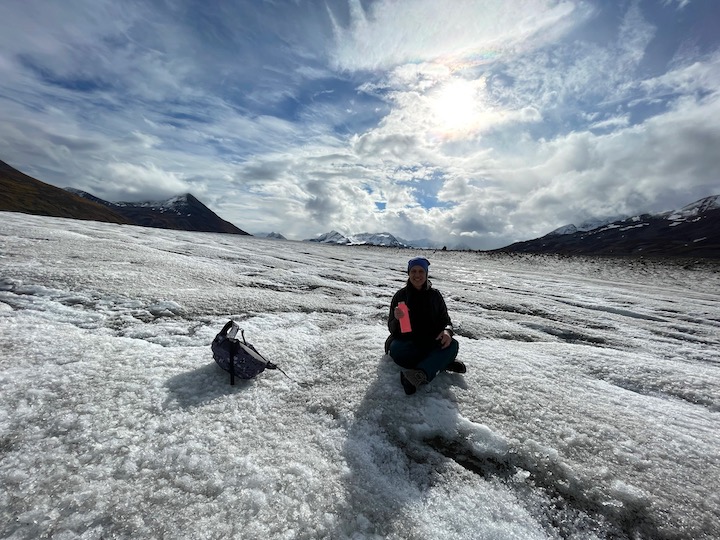
Having a sip of tea on a glacier. By far the most remote place I’ve ever been.
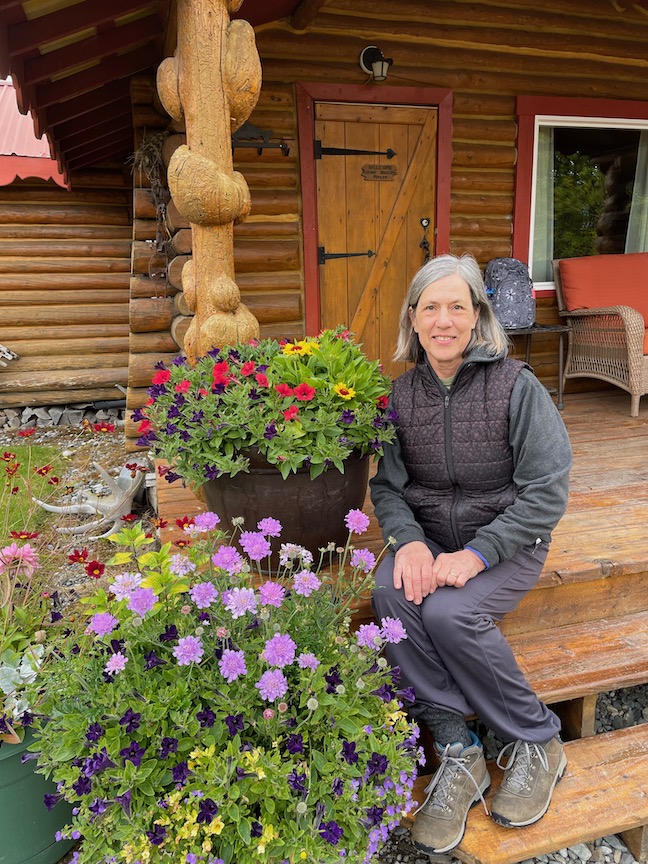
Sitting on the front porch of our cabin with flowers that made me feel right at home.

And walking up to the lodge (Called Ultima Thule, which means “beyond the end of the known world”) after a day of adventuring in the wild, I realized how successful Donna had been – and how important her vision was. When I saw old familiar friends in the pots of colorful flowers, I began to settle back down into a more familiar perspective. A dahlia blossom is both stunningly beautiful and comforting at the same time. It looks like home. It is beauty that I can appreciate without over – extending my senses.
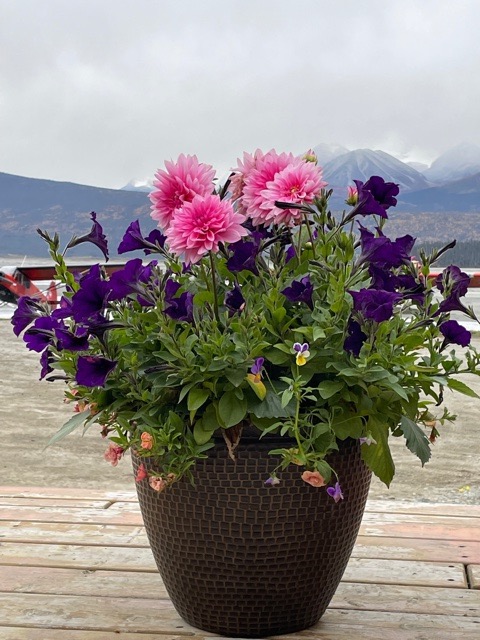
I’m sure that doing technical climbs to summit mountaintops and walking 30 hours UNDER a glacier to get back to civilization is incredibly difficult but after listening to Donna describe what it’s like to garden at the edge of the world, I suspect that gardening must rank among her greatest accomplishments.
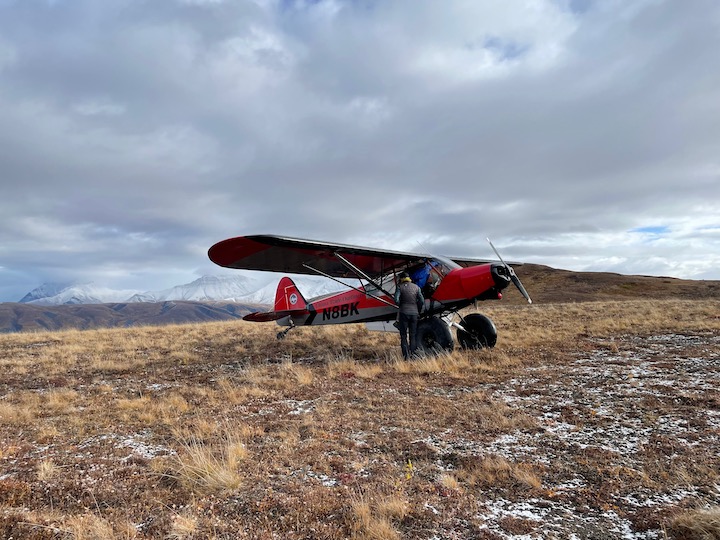
Imagine this: Temperatures that can dip as low as 78 degrees BELOW zero. Trying to garden in a place where every single bit of equipment, from the trowels to the seeds to the bulldozers, have to be brought in by plane. Months of wind and dust that can leave 1/8 to 1/4 an inch of silt on every surface every day. Seeing “terminator dust,” the first snows on the surrounding mountaintops that signal that winter is just around the corner. And then composting everything. Everything. She starts the garden from scratch every year since nothing survives the winters. Let me hasten to add that Donna’s garden is not small. She says that every year she plants approximately 20,000 plants in pots and beds.
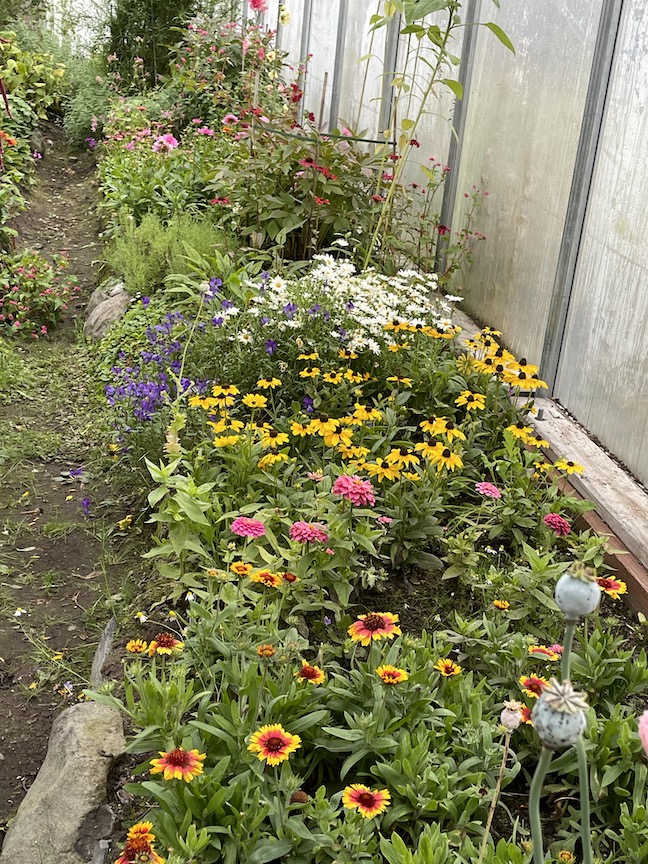
By mid-September, Donna’s greenhouses are full of healthy and enthusiastic plants. In another week or two, as terminator dust creeps down the mountains, all of this will be composted.

Along with the many challenges, though, Donna does have a few advantages. For one thing, she gets amazingly rich topsoil straight from the mountainside behind the lodge. And she has sunshine. Lots and lots and lots of sunshine during the summer. She says that the rate of growth is astonishing. Things will double in size overnight.
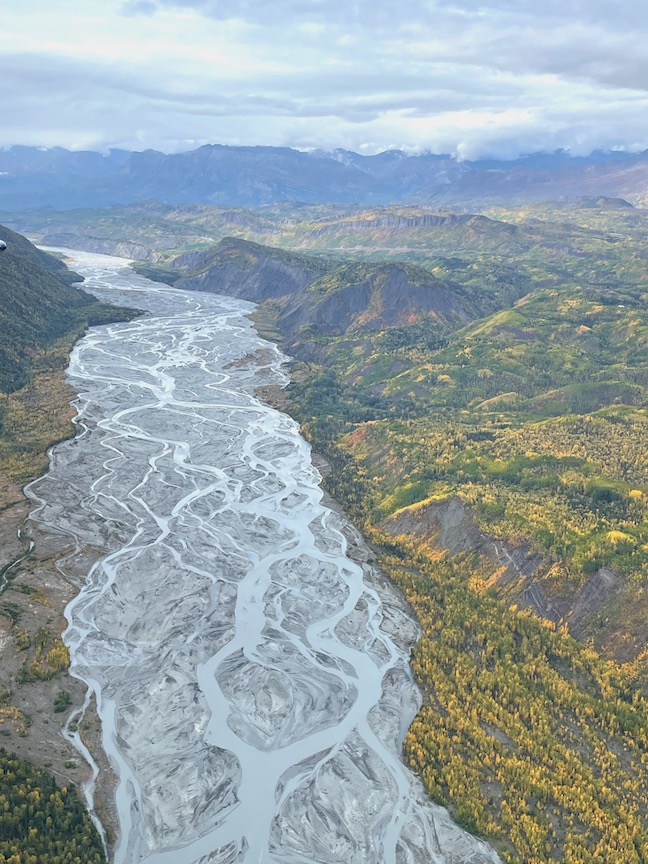
The Chitina River has changed course so many times, Donna and Paul have had to move everything – every building, every bit of equipment and all the garden – three times!

Being in Alaska and talking to Donna about gardening was a surreal experience because everything was so different and somehow seemed magnified many times over. It is not a place where I could live or garden for I don’t have the skills for either one. But as different as Donna and I are, we found instant companionship and friendship based on our shared love of digging in the dirt. And this is why I garden, not only to plant things that are beautiful but because I love being part of a community of people with this shared passion, wherever their dirt might be.
Gold in “them thar hills”

If you ever watched a Bugs Bunny cartoon, you’ll probably remember Yosemite Sam yelling, “there’s gold in them thar hills!” although I never remember Sam actually finding gold.

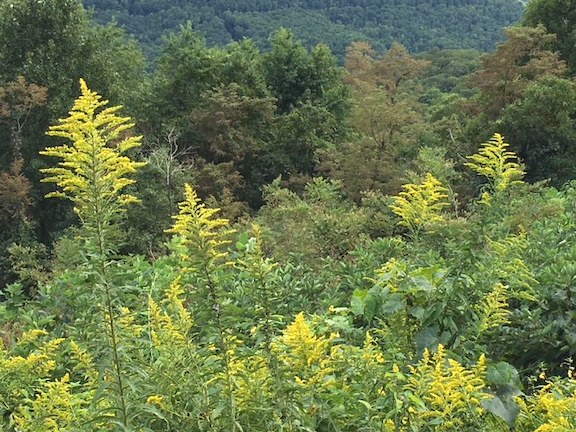
Perhaps Yosemite Sam would have had more success had he been looking for Goldenrod rather than the hard to find but obsessively sought after precious metal. These days all our hillsides are beginning to turn gold with the blooms of this autumn native.
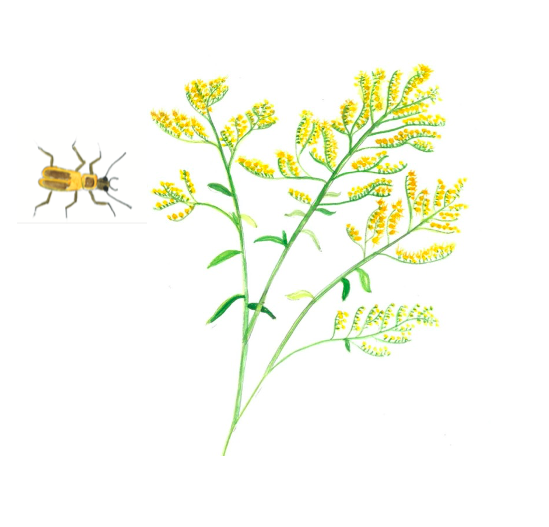
You can find goldenrods throughout North America. There are over 125 species native to the United Sates. These interbreed easily and it’s often difficult to determine exactly which species you’re looking at. But, it’s easy to tell when you’re looking at some kind of goldenrod. They have tiny, daisy like flowers clustered together on a long stalk and almost always, the flowers are a golden yellow color.
Goldenrods are short day bloomers, meaning no matter what the temperature, when the days begin to shorten, these are going to bloom.

These plants are essential to pollinators such as bees, flies, wasps, butterflies and beetles, especially the goldenrod soldier beetle. The leaves are used by many different butterfly species as larval food.

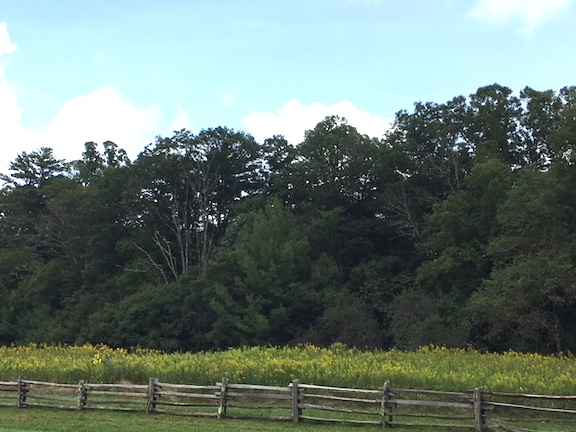
Along the Blue Ridge Parkway, they think so highly of their goldenrods that they fence them in. Ha, just kidding.

Western settlers made a tea from goldenrods and used it to treat kidney stones, toothaches and sore throats. Salves were made and used topically to treat sores and infections.

During the Revolutionary War, after colonists dumped imported tea into the Boston Harbor, many plants, particularly goldenrod were used to make a substitute tea called “liberty tea.” It was probably stronger on patriotism than it was on taste but it was a valiant act of liberty.

Contrary to commonly held beliefs, goldenrod does not cause hay fever. The culprit is ragweed, which blooms at the same time. Goldenrod makes a lovely cut flower and is a welcomed addition to any fall bouquet.

Seeing heaven in a wildflower

To see a world in a grain of sand,

And a heaven in a wild flower,

Hold infinity in the palm of your hand

And eternity in an hour. William Blake

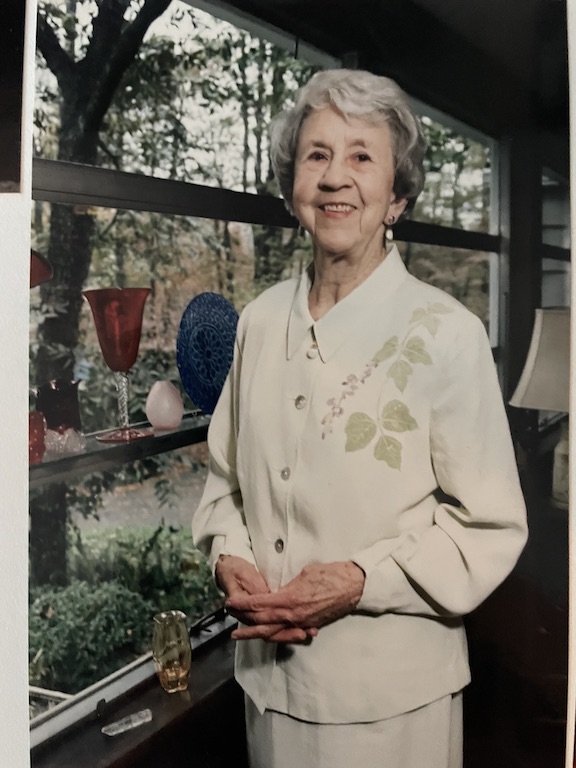
My mom, Lois Coogle, was never much of one for “store bought.” She was a firm believer in making it yourself whether it was furniture or clothes for her four daughters. My brother, Lee, seemed exempt from homemade clothing. Lucky Lee. Mom was better with a paintbrush than a needle.

Mom dressed for her 60th wedding anniversary party.

Not spending money was just one of the reasons Mom liked to do things herself. The other was that she had an incredible and impressive ability to see potential in things other people would either ignore (at best) or throw away (more often.)

As a child, I hid my head in embarrassment more than once as my mother stopped to go through the neighbor’s trash piled on the street. Inevitably she’d drag out something – a broken chair or an old lamp – and bring it home. As soon as she walked in the door, she’d call out “Ken! (my dad) Ken! I have a little five minute job for you!”

Ken and Lois Coogle

My dad, probably the most patient man in the world, would take her trash and make it functional and then she would infuse it with creativity. She’d clean and paint it a plain color then add beautiful designs of fruits or flowers. And then she’d sell it, making a tidy profit from things other people had thrown away.

Mom’s trash – to – treasure attitude extended to flowers. I never remember her buying flowers for anything. “Why would you?” she would ask, “when the garden and the woods are full of things you can use.”

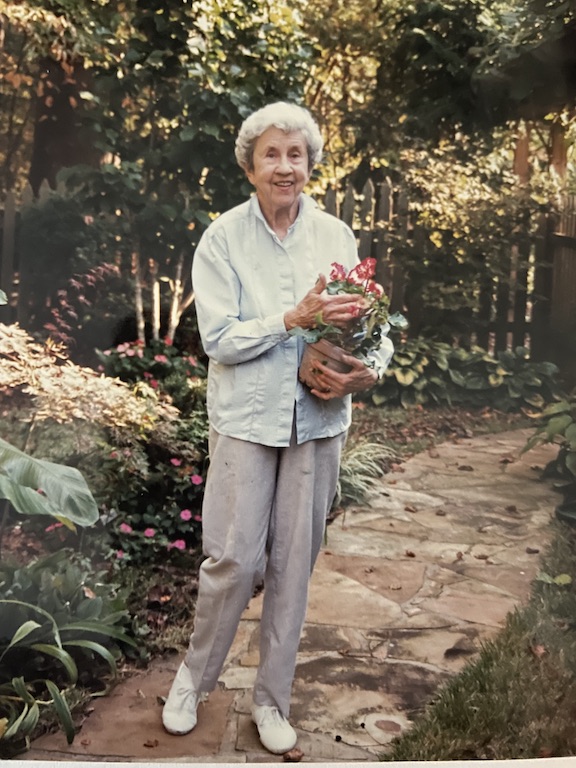
Mom in 2002

For decades she took “flower” arrangements to her Sunday school class at Peachtree Road United Methodist Church. Every Sunday. When the garden was in bloom, it wasn’t a problem. Daylilies and phlox, roses and daisies went into her arrangements.

In the dead of winter, though, her arrangements became more creative. Nothing was without potential. She never saw weeds, she only saw wildflowers. Dried grasses, bare twigs, autumn leaves, pine branches…..she could somehow make them all look elegant and beautiful – or at least interesting.

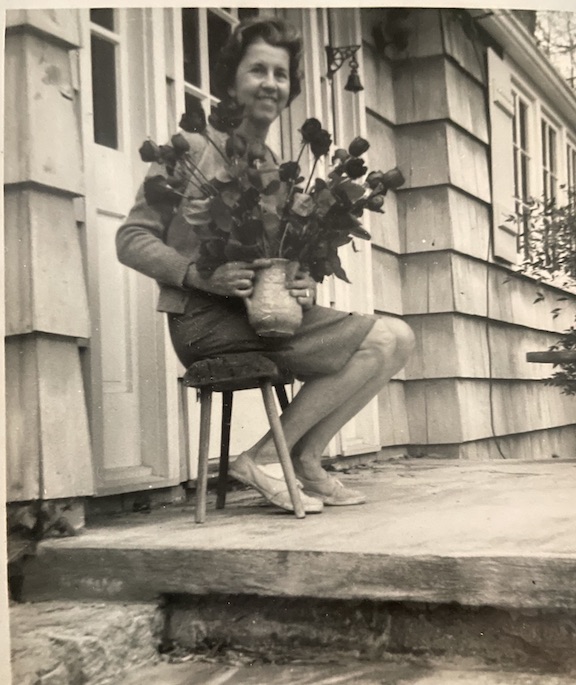
The only store bought flowers Mom loved were the roses Dad got her on their wedding anniversary, one for each year they had been married. The final count was 64!!

If anyone could see “heaven in a wildflower” I’m sure it was my Mom. We never talked about grains of sand, but I am completely confident that in them, she could see an entire world.

I am so grateful for this legacy, so proud to be her daughter. Every time I write a line or paint a flower, I think of her, but perhaps I miss her most when I pick a clump of weeds and call them wildflowers. I imagine her in heaven, picking weeds and painting something beautiful on the pearly gates.

Taking stock – a late summer review

The weather-person in Atlanta said the other day that being outside was like walking into a dog’s mouth. Heat and humidity are taking their toll both on humans and the garden. It’s a great way, though, to separate the men from the boys, the women from the girls, the survivors from the victims.

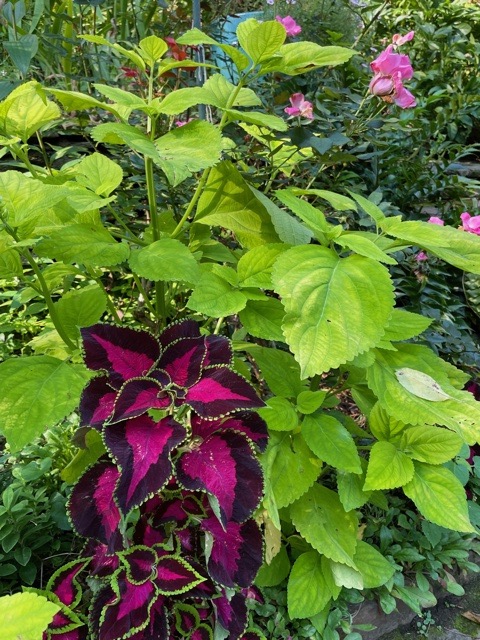
Coleus, which I started indoors from seed has taken 4 months to grow and fill in but it looks great in my late summer garden.

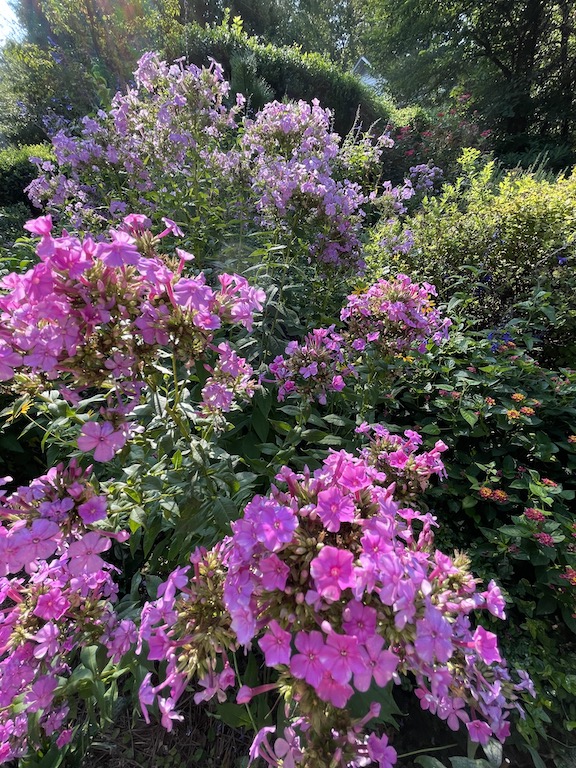
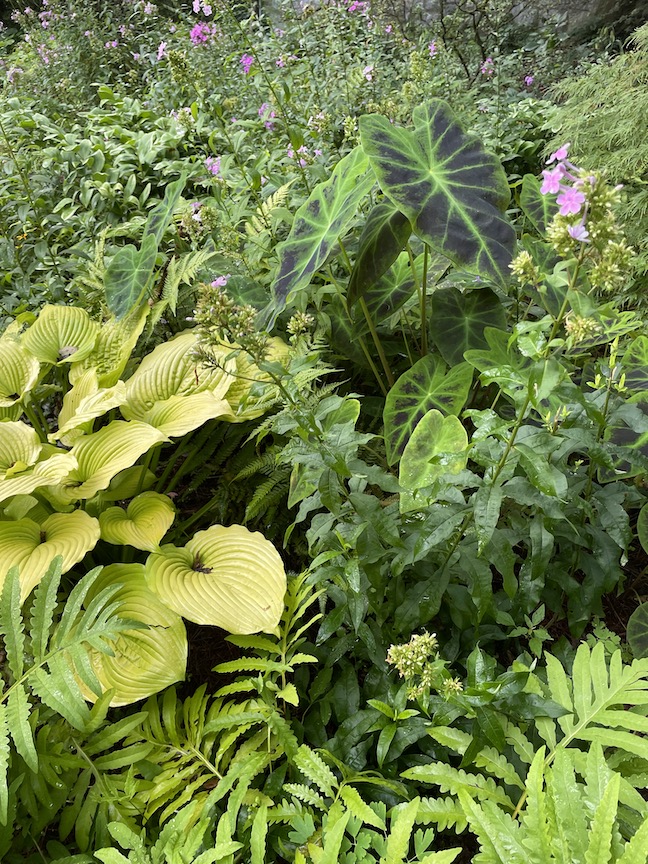
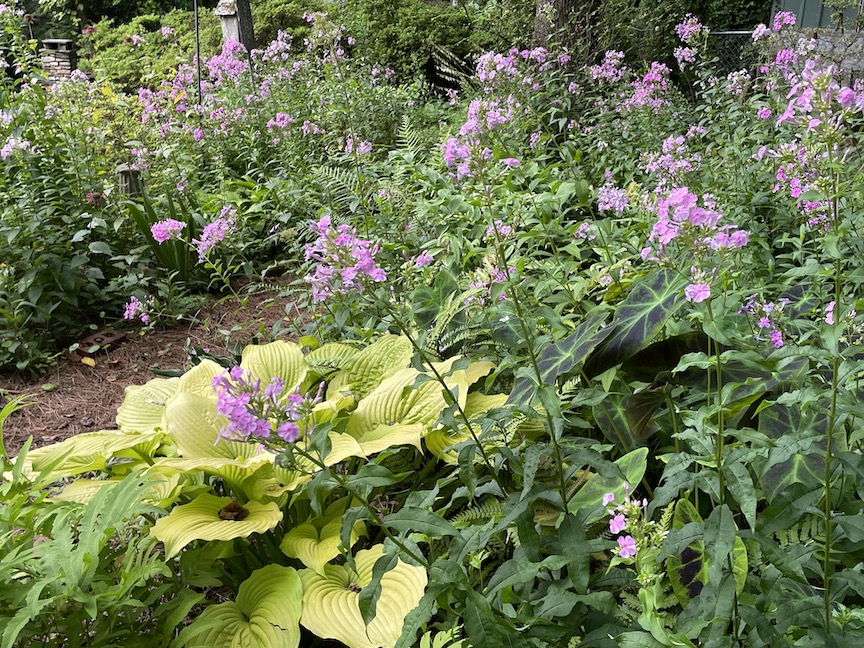
I have to give pink (and an occasionally white) phlox the highest marks. This has been in bloom for about 7 weeks now and still looks good. It is native and spreads easily. Some may call it an aggressive grower but because it’s native and really doesn’t choke out other plants, I just call it “an enthusiastic grower.” Not only does it look good for a long time period, it’s also an excellent cut flower and pollinator plant. The butterflies just phlox (oh sorry, flock) to it! It WAY outperformed bee balm, which only bloomed for a few weeks and never attained the brilliance that I’ve had in years past.

I absolutely love my phlox. I had visions of all white phlox but nature had other ideas and reverted back to the natural pink color. Good thing I love pink too!

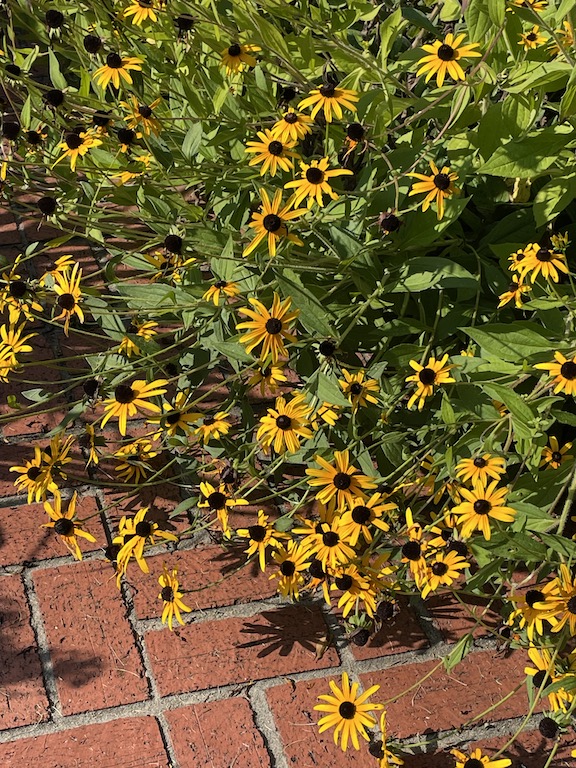
Black-eyed Susan used to be a no-brainer for my garden and I have extolled its virtues many times. And it still is one of my favorite summer standards. But this year, small black glossy bugs ate all the buds! off the plants in the back. The front yard “Susans” seemed untouched. I carefully shook off as many as I could and sprayed the plants with insecticidal soap a couple of times, all of which I think had little effect. I also clipped off all the mostly eaten buds and hoped that they would survive and maybe even bloom again, which they did! Not as prolifically and beautifully as other clumps, but I do have a nice smattering of flowers now.

You can see this clump of Black-eyed Susans all the way down the street. They last a long time, make a good cut flower and provide seeds for songbirds.

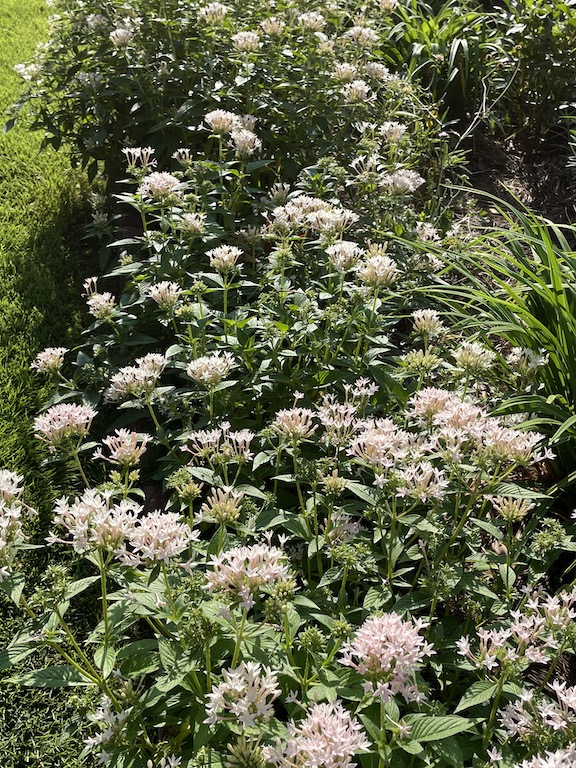
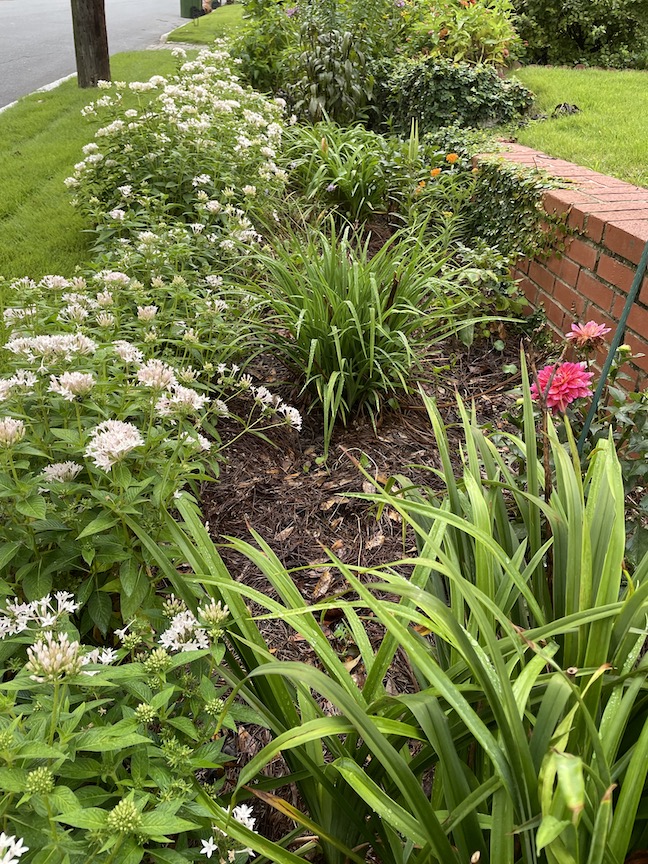
I usually plant a long row of something along the street in the front. I like to put in white flowers since I have such a cacophony of colors that appear at various times in the garden. I’ve tried all kinds of things including petunias and vinca but have found that pentas (which are white-ish) not only survive but look the best for the longest time – going on 4 months now.

Pentas have bloomed continually for 4 months. They don’t get leggy and don’t need dead-heading, making them a welcomed addition to the garden.

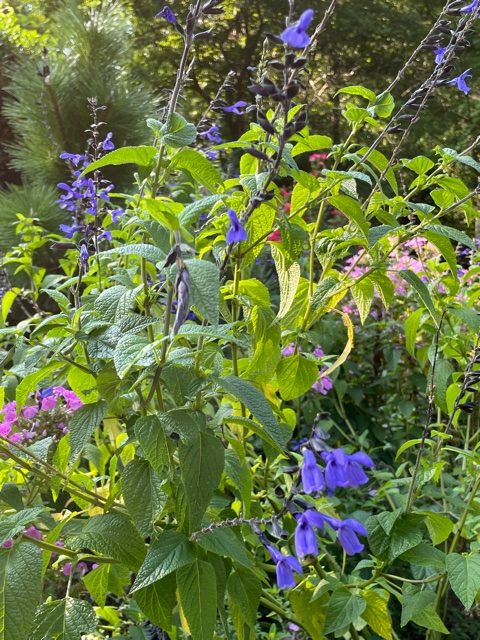
Even though it gets HUGE every year without a tremendous number of flowers, I always make room for blue salvia in the front because of the hummingbirds. It is truly better than a hummingbird feeder and I can sit and watch the little creatures dive and flit and fly and occasionally fight one another over a particularly tasty blossom.

Better than sugar water in a feeder, blue salvia has proven to be a hummingbird magnet. If you think hummers only go to red flowers, this will prove you wrong!

There are definitely empty spaces in the garden as things wax and wane and It takes tremendous self control to not fill up those spaces with something stunning and colorful and impressive. But I’m trying to learn patience and just give things room to grow and develop and bloom. It’s much like when I started playing the piano again after taking a few decades off. It was really difficult for me to give the rest notes their full count. I wanted to fill every moment with beautiful sound. But I learned that music – and the garden – is not just about the notes and the flowers but about the empty spaces in between, which give you a place and a time to breathe and appreciate .

So………I’m…………trying……….to…………..leave………………..more……………………….empty………………………..spaces…………………………in……………………my……………………life.

Happy Gardening!

Abundance in the garden (mostly weeds)

You know that feeling you have when you look in the mirror and think, “I have to get a hair cut. Today. Right now. I can’t stand it any longer.” That’s the same feeling I got this morning looking at my garden. I have to do something about this. Today. Right now.

Sometimes it’s hard to know where to start. And to determine what’s a weed and what’s not!

I have had the same list of excuses everyone else does to avoid weeding the garden. It’s too hot. There are too many bugs. It’s too hard. Nobody will notice anyway. I don’t have my shoes on.

But finally, I just couldn’t stand it any longer so, donning long sleeves and a hat, I whistled for my faithful dog, Sadie, and headed to the back, bushwhacking my way through the weeds.

I weeded for a while, and got into the rhythm of the “grab, pull, toss.” And, once into it, with plenty of time to think, I realized that there was a parallel list of good reasons to weed.

1. No one bothers you. Not my husband or a grandchild or a grown child. They all realize if they stick their head out the door to ask me something, there is a very real threat they will get roped into weeding. So, I repeat, no one bothers me.

Uncovering a path was very satisfying, like finding a space to breathe in.

2. With so many weeds to choose from, I don’t have to move around a lot. I can stand or squat in one place for a long time with plenty of weeds to keep me busy.

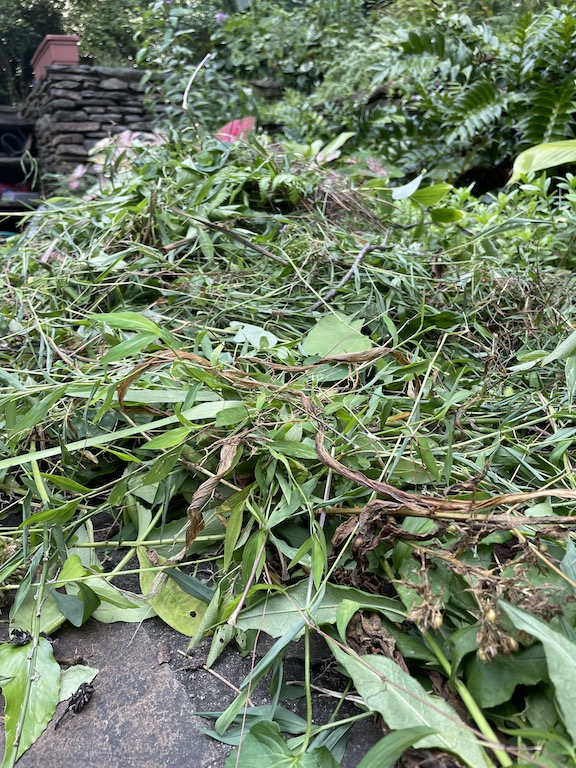
3. There is a satisfyingly large pile of weeds to look at, providing evidence of how hard I am working. (It also provides evidence of how long I’ve neglected the garden but we won’t talk about that.)

This pile of weeds took about 20 minutes to create – a fact that is both satisfying and a little embarrassing. How did they grow so fast?

4. Then, there are the obvious reasons. Removing all those weeds actually gives the garden plants room to grow and breathe and even spread. AND, an added benefit, I always uncover things I forgot I planted, such as the azalea shrub I put in last spring. I knew it was there someplace!

Different people have different methods of weeding based on personality type. My sister, Sharon, I’m sure is a slow and meticulous weeder because that’s how she does everything. Other people are slap happy, let’s get this over with, grab as many as you can in the shortest time possible kind of weeders. Guess which I am?

Being a fast weeder has a lot of advantages (as in you finish sooner!) but you will also inevitably have an “oops” moment when you look at a fistful of weeds only to discover that you’ve pulled up your prized…..something!”

I’ll have to admit that a neatly weeded garden is truly a pleasure to view.

My Dad used to have a T-shirt that said “Weed them and reap,” clearly a play on the poker saying, “Read them and weep.” But when I inadvertently pulled up the small dahlia that I’d been nurturing since last spring, I thought it should probably read, “Weed them and weep.”

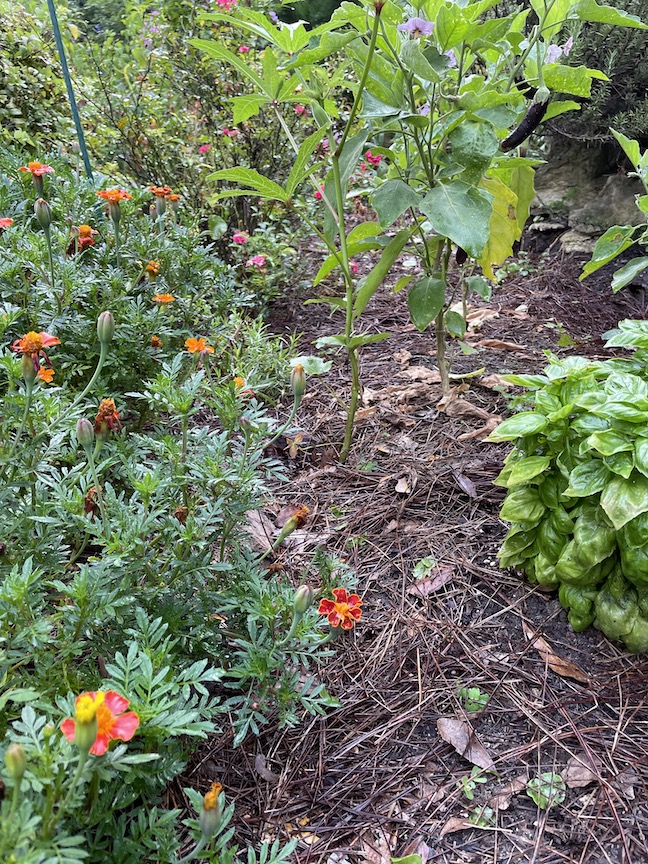
Hopefully, weeding around the vegetable and herbs will increase harvest substantially.

I try to plant the garden so that there’s not much room for weeds but inevitably, they find their way in and around and sometimes through the garden plants. But I don’t really mind. Weeding makes me feel as if I have just a little bit of control over something in life! Even if it’s temporary.

Tomatoes – with a little basil

Whether you say tomahto or tomayto, baysil or bahsil, the fact remains that the twin gifts of summer are home grown tomatoes with some spicy green basil on the side.

For me, it’s a constant challenge to get to the tomatoes before the squirrels do. I’ve tried all kinds of things – fencing, netting, different locations and on and on but somehow those pesky little creatures always seem to wiggle their way in and eat about half of my tomatoes. I don’t mean half the crop, I mean half of each tomato. Arghhhh.

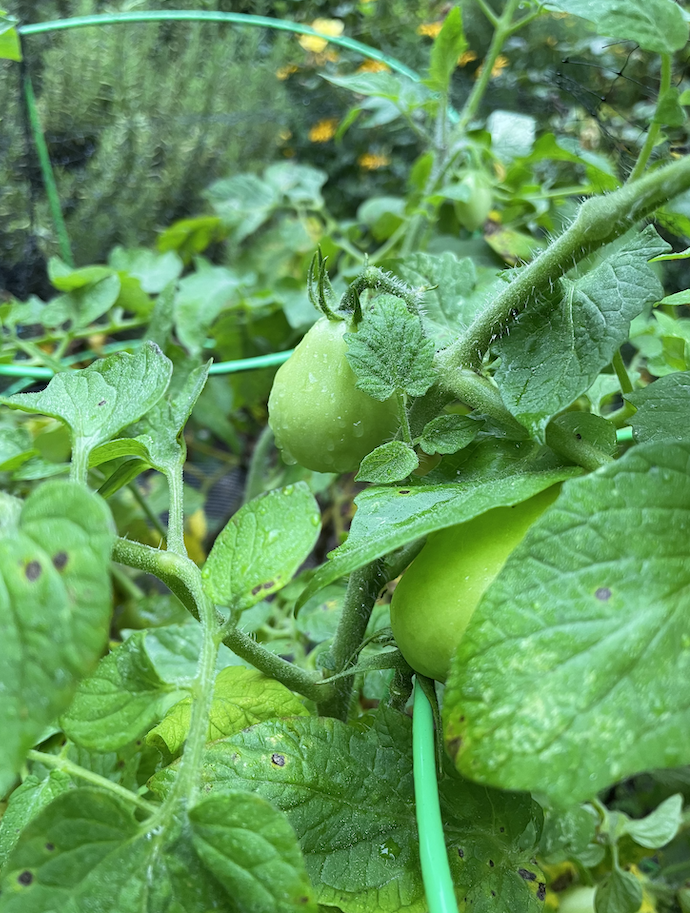
It does help to pick them before they’re all the way ripe. Though I lose some flavor, at least I get some tomato. This year I grew Roma tomatoes which have produced magnificently.

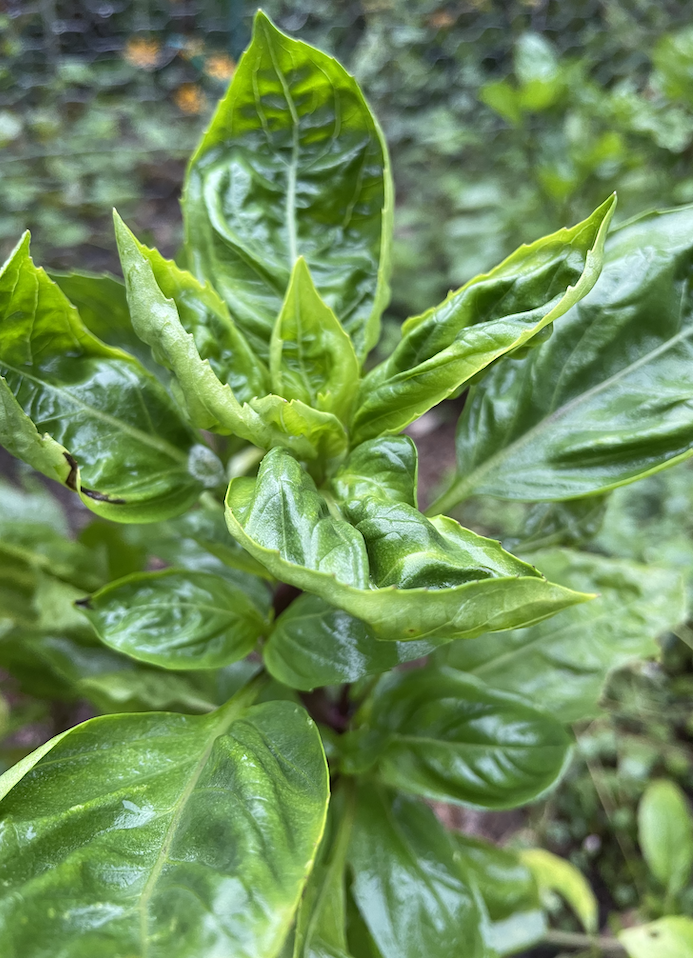
I tried growing different basils from seed this year and had good success. My favorite cultivar is called “Cardinal.” It has dark red, sturdy stems and though it doesn’t seem to be quite as abundant as the classic basil, the taste is absolutely fantastic. It has a more robust flavor, with a bit of a kick to it. I don’t think even I could eat an entire plate of it, but tossed in with other greens or in a caprese salad, it is wonderful.

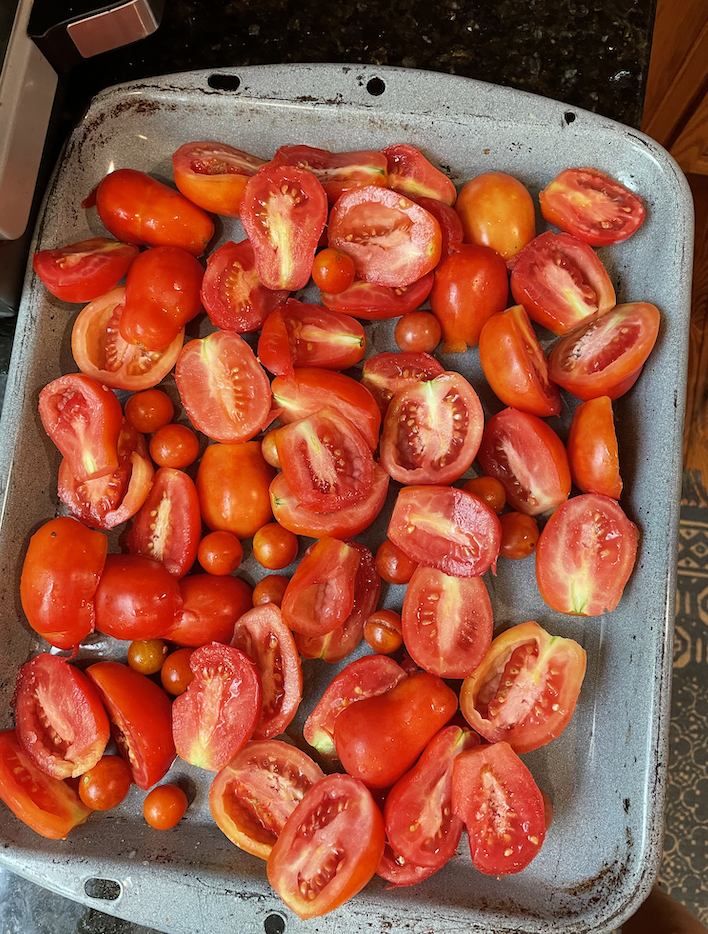
Perhaps my favorite way to use the summer garden gifts is to make up a large batch of tomato basil soup. It’s fast, easy, healthy and delicious. What more could you want? Just halve the tomatoes and roast them for 40 minutes, add (a lot of) basil, sautee onions and add seasonings. A few minutes in a super blender, such as a Vita-mix makes it unnecessary to peel and seed the tomatoes ahead of time (hallelujah!)

There are endless variations. If you want a richer, creamier soup, substitute half and half for the milk. If you’re vegan or vegetarian, use vegetable broth instead of the chicken broth and milk. For an extra kick, add some of your favorite hot sauce. You can serve it warm (my preference) or chilled and can top it with avocado cream, a dollop of sour cream or some shaved Parmesan.

Anyway you do it, this is a great way to take advantage of summer’s bounty. Enjoy!!

TOMATO BASIL SOUP

3 pounds Roma tomatoes, halved

6 tablespoons olive oil, divided

1 tablespoon salt

1 1/2 teaspoons ground black pepper

2 cups onions, (Vidalia, if possible) chopped

6 garlic cloves, minced

2 tablespoons butter

1/4 teaspoon crushed red pepper flakes

1 (28-oz.) can of plum tomatoes, including the juice

4 cups basil leaves, packed

1 teaspoon fresh thyme leaves (or 1/4 teaspoon dried)

1 teaspoon fresh oregano (or 1/4 teaspoon dried)

3 cups chicken broth or vegetable broth

1 cup milk (or half and half, or more broth)

Slice the tomatoes lengthwise, toss in 4 tablespoons of olive oil, add salt and pepper and roast in a roasting pan at 375 degree oven for 40 minutes.

In a large stew pot, sautée garlic and onions in the butter and remaining 2 tablespoons oil. Cook until soft and beginning to caramelize. Add red pepper flakes, basil, canned tomatoes, thyme, oregano and broth. When roasted tomatoes are done, add them to the mix. Cook for about 30 minutes.

Allow to cool, then adding a bit of milk (or additional broth) to each batch, process in the super blender until smooth. Makes about 7 – 8 servings. Yum.

“The Art of the Appropriate Response”

Although Jack and I share many passions (travel, hiking, grandchildren, good food etc.) we also have our own individual enthusiasms. Over the 20 plus years that we’ve been together, we have both learned quite a lot about the value of an “Appropriate Response.” We decided early on that “Yes, dear” lacked imagination and sincerity and would not be accepted as an “Appropriate Response.”

Jack is wildly enthusiastic about bicycling, and in particular about the Tour de France. Me? Well, if you’ve read this blog even once, you know that I am equally wildly enthusiastic about my garden. I’m quick to recognize that when it comes to making an appropriate response, I have it much, much easier. After all, the gardening season lasts for months whereas the Tour only lasts 23 v…e…r…y. l….o….n….g days.

We both have stock phrases which we have fine tuned over the years. Jack has learned that “You’ve worked so hard!” is almost always a good response to my commenting on my garden. It works for both celebration and commiseration. For example, Me: Bugs ate all my Black-eyed Susans! Jack: Aww, and you’ve worked so hard. Or, Me: I don’t think the peonies have ever looked better. Jack: Wow, and you’ve worked so hard!

My stock response to the Tour is to say, “Wow, they are amazing athletes.” This, too, works in a variety of situations, from time trials to peddling up mountains in a snow storm. However, as I found out, it’s not appropriate for ALL situations, as when Jack was telling me about stupid fans standing on the roadside, endangering the course. “Wow, they’re amazing athletes” was definitely not an “Appropriate Response” to that one.

Basically, we just want to show interest and support for each other. Even if we don’t happen to share these particular interests, we love each other enough to want to be involved. But not too much. The trick is to find a response that is appropriate but that doesn’t provoke the need for further information or explanation. It’s a tricky business, this finding an appropriate response.

I have found though, that spending a few minutes on Google is sometimes a good investment. For example, I could say something such as “Wow, can you believe that Van Aert was 21 SECONDS!!!! ahead of Kasper Asgreen in the time trials??” My hope, of course, is that such a statement would render him absolutely speechless for the rest of the Tour! But, knowing Jack he wouldn’t even blink before launching into the statistics of the last five years of time trials.

Which is okay, because then I could tell him all about the challenges of starting pansies from seed…..they need cool but not cold temperatures, and where can you find that in August? and then, is this really the best time to be starting them if I want plants by fall? They must be easy to start from seed, though, since they are so ubiquitous at the nurseries. Maybe it’s the kind of soil……….

Jack? Jack? Are you still there? What’s that you say? Something about working hard?

Well, thanks. And I think they are amazing athletes!

The American Desert

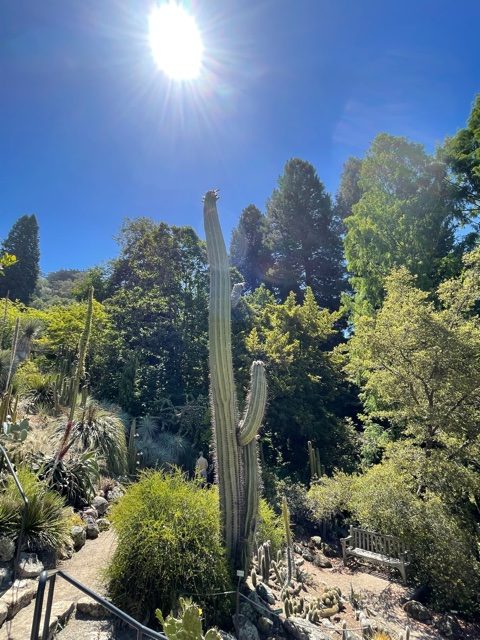
The University of California at Berkeley Botanical Garden is a wonder to behold. While visiting family in Oakland, we spent the morning exploring the garden. It is divided into regions and countries, profiling native plants. Though I felt most at home in the “Eastern Woodland” area, I was most fascinated by the things in the “Plants of the American Deserts” area. Let me hasten to add that “American” refers to both North, Central and South.

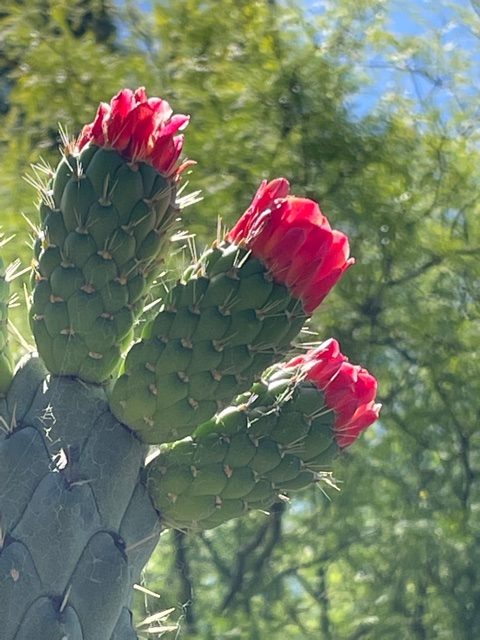
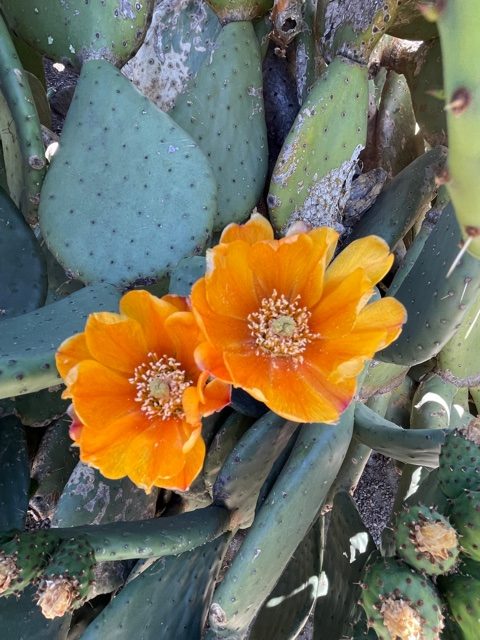
Tha plants native to the desert are both alien and awe-inspiring to me, partly because they are so different from the plants in my own garden. Sporting big, thorny, thick leaves, the cacti demanded – and received – the respect of distance. Spines from the Opuntia, or prickly pair cactus, are barbed, making them almost impossible to extract if they become imbedded in your skin. The fruit is edible and considered delicious, though harvesting and extracting the juice from the fruits without getting speared is a daunting task.

Other cacti in the same genus, such as the Beaver-tail cactus, sported beautiful blooms in yellow, orange and red.

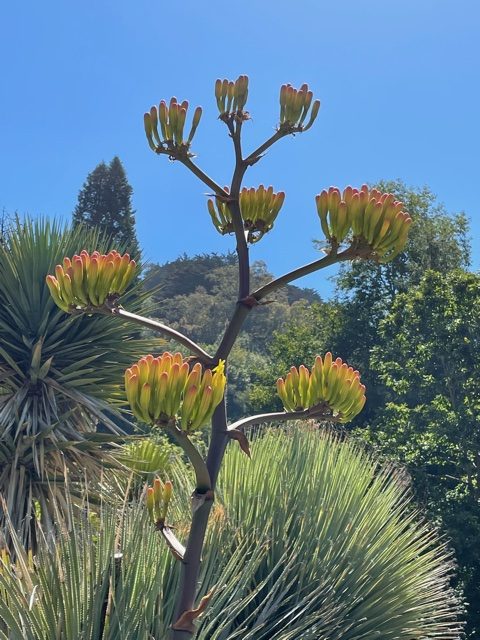
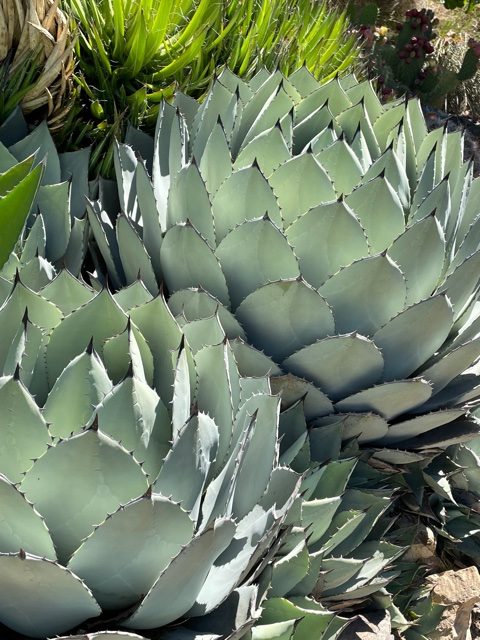
There were several Agave species found in the gardens, each one more outrageous and unusual than the next. Agave parryi, native to southwestern parts of the U.S. is also called the “artichoke agave” because of the configuration of the leaves. Bright yellow blossoms are found on stalks that can grow as tall as 12 feet.

The plant dies after flowering because it takes all of the plants energy and resources to produce these magnificent blooms. Blue agave, A. tequila, is the source of not only tequila but also of agave “nectar”, a syrup often used in place of sugar. Before you get too excited about using this “natural” sweetener, you should know that agave syrup has a higher fructose level than even table sugar.

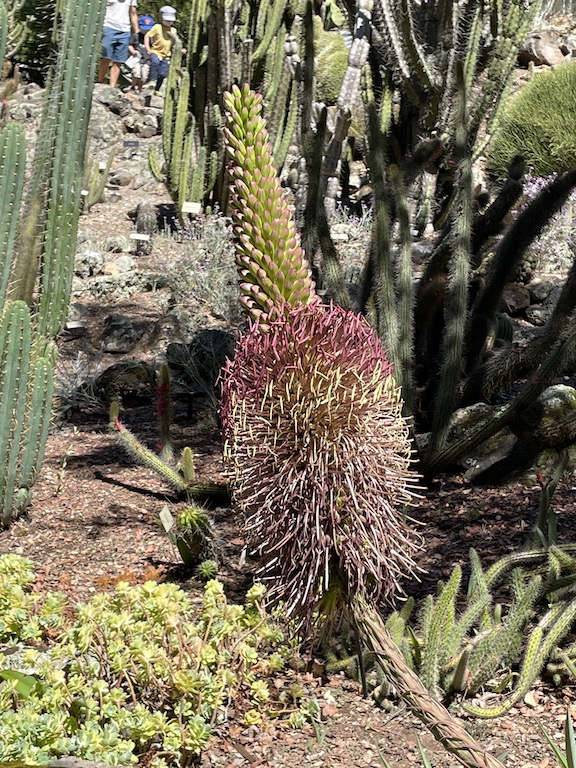
Agave mites is just plain strange looking. The leaves are much smaller and less imposing than other agaves but the flowering stalk, which can grow 8 feet in length, shouts for attention.

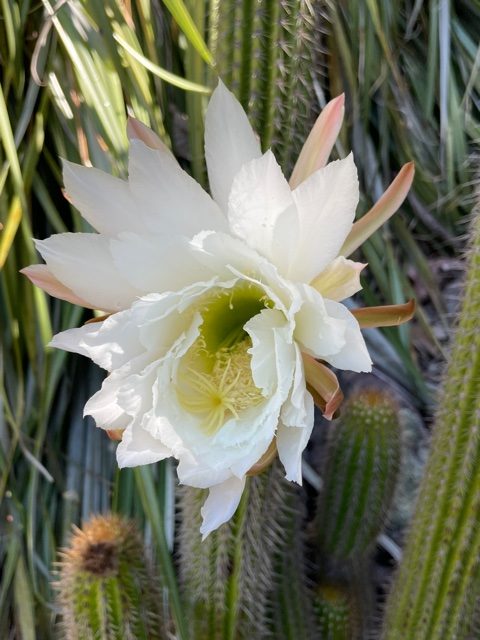
Echinopsis is known as the hedgehog or sea-urchin cactus and has startlingly beautiful flowers which occur at the ends of stout, stumpy branches. As indicated by the name, the plant is covered with sharp spines, similar to those found on a hedgehog.

Like reading science fiction, my experience of seeing these plants was one of wonder at things so alien and unusual. All spiny and prickly, I wouldn’t want them in my back yard, but then again, they wouldn’t want to be in my backyard! Everything has a place and frankly, I’m glad my “place” is not a desert.

Those blinking fireflies

Summer evenings in times long past were pretty simple at our house. After a dinner of mostly home grown vegetables (green beans, yellow squash, okra and tomatoes) we’d play a game of hopscotch until it got dark enough to catch fireflies. Hot and sweaty and armed with a mason jar with holes punched in the top, my siblings and I would head to the back yard to catch some magic.

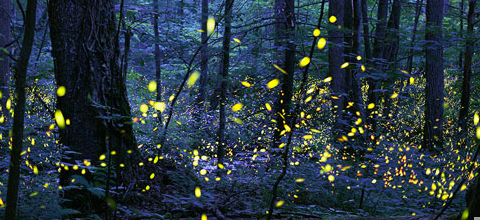
Photo courtesy of GSNP

Squealing every time we caught one, we’d compare our harvest, then let them all go, only to be caught again the next night.

Photo courtesy of Parents.com

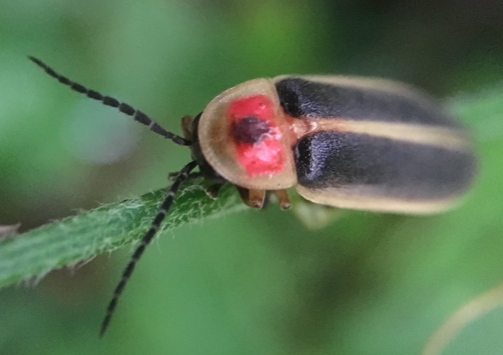
My attraction to fireflies is partly nostalgia but partly just because their magic continues to fascinate me even after all these years. At an early age I was taught the science, that they are not really flies but beetles, that the “fire” is actually a bioluminescence that is used primarily to attract mates and that each species has a unique flashing pattern so that if you watch carefully enough you can distinguish one species from another.

Without the blinking light, fireflies are relatively plain and uninteresting looking. Photo courtesy of Xerces Soc.

But what I’ve only learned recently is that the flashing lights are also used to attract prey. For example, the Pennsylvania firefly uses bioluminescence to attract the Big Dipper firefly, which they then eat. There are over 2000 species of fireflies worldwide, with 170 species living in the U.S. and 50 living in Georgia. Bioluminescence is actually incredibly efficient, using almost no energy to produce light. In comparison, an incandescent lightbulb is only 10 percent efficient, losing 90% of the energy to heat.

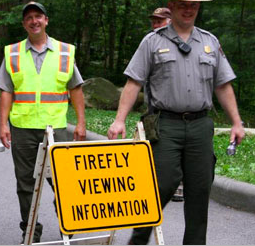
In the Smoky Mountain National Park, fireflies have become a tourist attraction. Each summer thousands of visitors flock to the park to see the Carolina firefly which displays synchronous blinking, meaning all the male fireflies blink together. Rangers at the Park explain that for three seconds, the males will blink and then all of a sudden they stop for six seconds. Then they “turn on” again and the pattern repeats over and over for a couple of hours.

Photo courtesy of GSNP

Like many species, firefly populations are suffering these days. The reasons are familiar: increased us of pesticides, habitat loss, water pollution and climate change. In addition, fireflies are suffering because of light pollution. Knowing the reasons for their decline aids us in knowing how to correct the problem. We can turn off outside lights at night, avoid lawn chemicals and pesticides, plant native trees and grasses and allow part of our landscapes to just be natural with fallen logs and tall grasses to provide habitats for the fireflies.

But science and the reality of declining populations cannot take away from the pure magic of the firefly. Fortunately, summer evenings in our backyard are still illuminated by these wonderful creatures. Now all I need is a good, flat rock for hopscotch.

The Hoh Rainforest

Summer has come to Georgia. When I step into the garden, heat and humidity envelop me and I feel like I’m in a rainforest. But then, last week, Jack and I were in a real rain forest and I realized that it feels completely different.

After visiting family in Hood River, Oregon we headed northwest to the Olympic Peninsula of Washington state. This is a large and astonishingly diverse and beautiful part of the state, home to Olympic National Park and the Hoh Rainforest.

The Hoh is one of the largest temperate rainforests in the U.S. and one of the wettest places in the continental United States, receiving over 150 inches of rain annually. (It actually can’t compare to THE wettest place in the U.S. which is Mt. Waialeale on the Hawaiian Island of Kauai which receives 460 inches of rain on an average!) Atlanta averages 52 inches a rain per year.

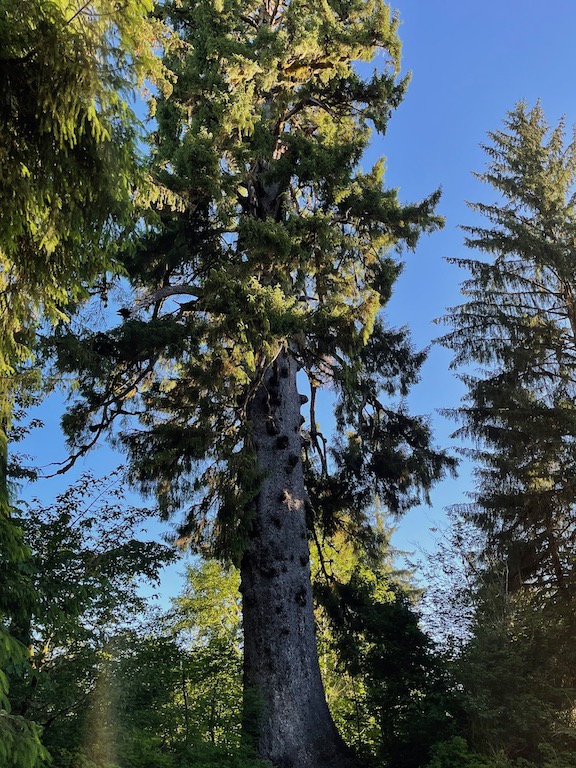
This is the largest Sitka Spruce in the U.S.and was growing a hundred yards from the small cabin where we were staying.

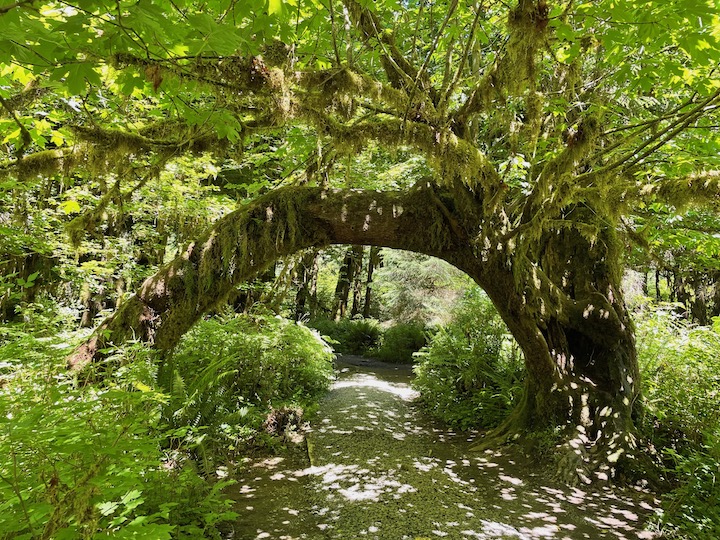
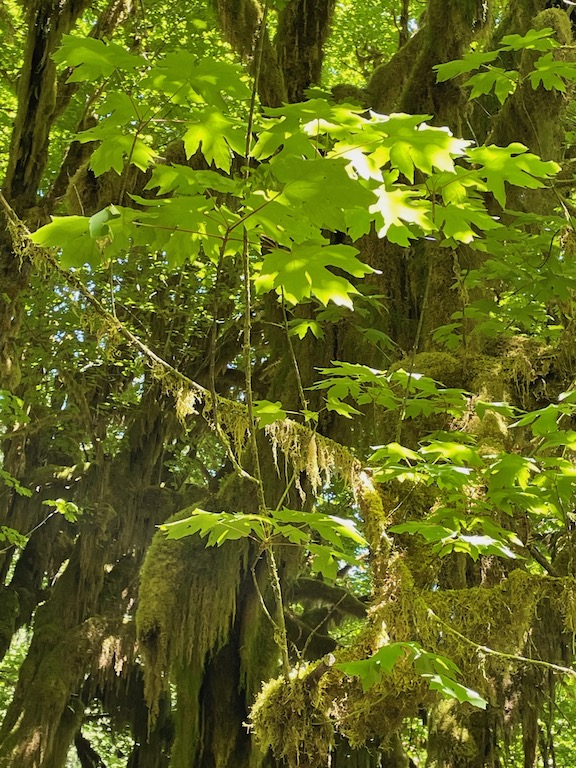
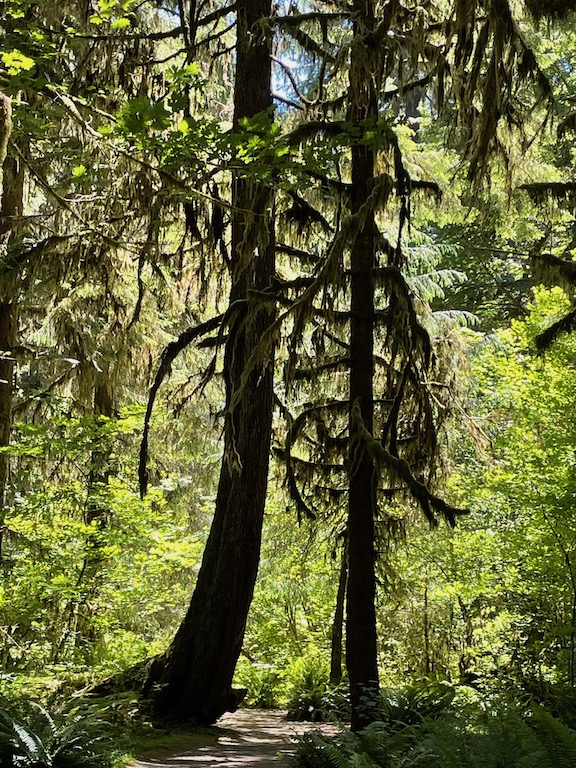
The forest is magical, with huge trees, many of which are over 300 feet tall. Sitka Spruce, Western Hemlock, Douglas fir and Western Red Cedars make up the majority of the tree population but in and amongst those are the truly stunning Big Leaf Maples. Though smaller than the evergreens, they are impressively large for a maple and covered with moss, creating a scene that looks primeval.

Large leafed maples are found throughout the rainforest.
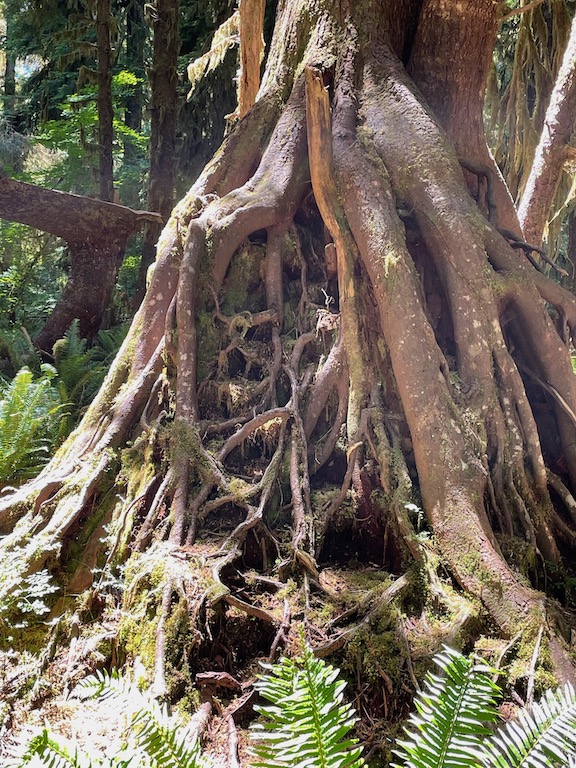
One of the more interesting features of the rainforest were the “nurse trees”, old trees that provide nutrients for younger trees. The younger trees put out roots that grow over the stump or log, reaching for the ground

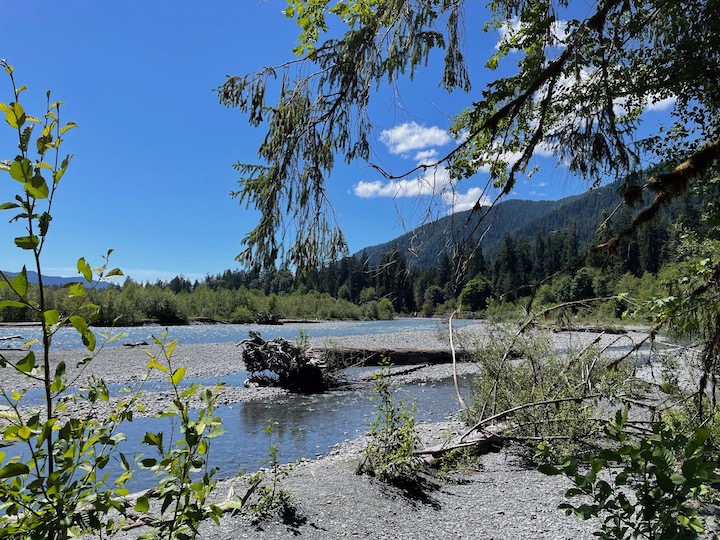
As we drove through a fairly remote part of the Park along the Quinault River, we were excited to first see an Olympic black bear – with her cub! and then later, a bobcat who ran across the road right in front of us. Luckily we were in the car both times! The Park is also home to cougar, Roosevelt elk and the northern spotted owl.

The Quinault River flows into Lake Quinault, which is truly beautiful.
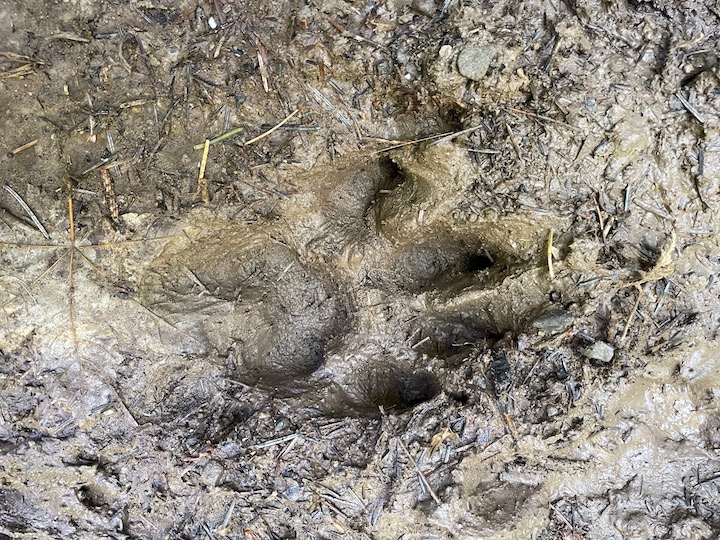
The trails are really muddy (it rains A LOT!) but there were some great paw prints. We finally decided that this was a bobcat print. I was just as happy to see the actual animal from the comfort and safety of the car!

We felt really lucky to be able to travel again and to see this truly beautiful and fairly remote part of our country. But even though I was thrilled to see the wildlife and the stately trees, it just couldn’t compare to seeing my beloved grandsons again!